
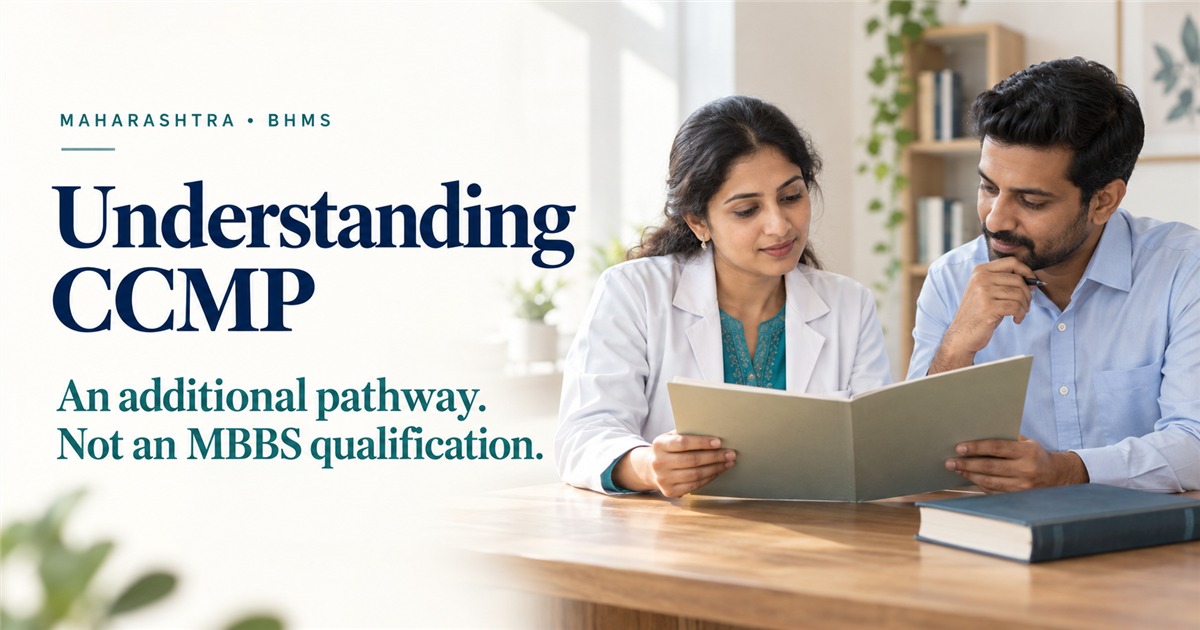
Short answer: yes, but only for one specific group. Maharashtra CCMP is a pathway that, Since 2026, Maharashtra has let BHMS-qualified homeopathic practitioners who complete a further one-year pharmacology course (CCMP) register separately with the Maharashtra Medical Council and prescribe modern medicine within their trained competency. It does not apply to Ayurveda, Unani, Siddha or naturopathy practitioners, and it does not make anyone equivalent to an MBBS doctor.
More than 10,000 homeopathic practitioners in Maharashtra have applied for permission to practise modern medicine. As of this week in September 2026, just 10 have actually received it, two of them in the Mumbai Metropolitan Region, according to The Times of India’s reporting on 7 September 2026.
That gap tells you almost everything you need to know about the CCMP story: real demand, real opportunity, and a regulatory process that is still working out exactly what it is willing to allow.
If you are a BHMS practitioner in Maharashtra, or you advise one, this is worth understanding properly, because the opportunity is genuine but narrower than the headlines suggest.
What Maharashtra “CCMP” actually is
CCMP stands for Certificate Course in Modern Pharmacology, a one year programme run through colleges affiliated with the Maharashtra University of Health Sciences (MUHS). It is open to homeopathic practitioners who already hold a valid, renewed registration with the Maharashtra Council of Homoeopathy.
The legal foundation goes back to 2014 amendments to the Maharashtra Medical Council Act and the Maharashtra Medical Practitioners Act, which created a pathway for CCMP-qualified homeopaths to register separately with the Maharashtra Medical Council (MMC) and practise modern medicine within that registration.
The state has argued in court that some form of this provision has existed in Maharashtra legislation since 1965, though the CCMP registration mechanism itself is what has been contested in recent years.
For most of the period since 2014, the course ran but the MMC registration side stalled, tied up in opposition from allopathic doctors’ bodies and repeated legal challenges.
In 2026 the state government directed the MMC to actually start registering CCMP-qualified practitioners. The first registration, per Outlook India’s coverage, went through in mid-2026. By early September, TOI reported the total had reached 10, against a reported applicant pool north of 10,000.
The general rule, and why Maharashtra is the exception
It helps to be clear about the baseline before getting into the exception. Nationally, the position is settled and has been for two decades: a Constitution Bench of the Supreme Court held in Dr. Mukhtiar Chand v. State of Punjab that a practitioner trained in one system of medicine cannot prescribe drugs from another, and Indian medical regulators refer to unauthorised cross-system prescribing as “cross-pathy.”
As recently as February 2026, the Telangana High Court reaffirmed the same principle in a case involving a BHMS practitioner, even while quashing that particular prosecution on a procedural technicality (the complaint had been filed with the police rather than with a court, as the law requires).
That is the backdrop against which Maharashtra’s CCMP pathway has to be read. It is not a sign that the national rule is loosening. It is a specific, statutory carve-out that Maharashtra has built for one defined group, registered homeopaths who complete CCMP, and it exists only because the state legislated it directly.
As a general rule, a BHMS qualification by itself does not authorise the practice of modern medicine; any exception depends on a specific statutory or regulatory framework in that state, and Maharashtra’s CCMP route is currently the most developed one on record.
Who this is actually for
This is important to get right, because it is easy to misread the story as “alternative medicine practitioners can now practise allopathy.”
They cannot, not through this route. CCMP is specific to registered homeopathic (BHMS) practitioners in Maharashtra who complete the approved course. Ayurveda, Unani, Siddha and naturopathy practitioners are not covered by this mechanism. Each AYUSH system has its own, separate and generally unresolved history with cross-practice, and lumping them together with BHMS/CCMP in one article would be both inaccurate and legally misleading. If there is a piece to write about Ayurveda or Unani practitioners and modern medicine, it is a different piece, state by state.
So the honest framing is narrower and, frankly, more useful: this is a second professional pathway for Maharashtra’s BHMS graduates specifically.
What it does and does not permit
Even within that narrower group, CCMP registration is not equivalent to an MBBS licence, and neither the government nor the MMC has claimed it is.
Interim court directions from 2025 required CCMP practitioners to stay within their prescribed competency and refer serious cases to fully qualified allopathic doctors, and that condition has continued to shape how the registration is being implemented.
In practice that means a CCMP-registered practitioner can prescribe within the scope of what the course actually taught them, under a separate MMC register created for this purpose, while remaining bound by ordinary professional conduct rules.
It does not mean unrestricted prescribing rights, and it certainly does not extend to surgery, anaesthesia, specialist obstetrics, intensive care or any procedure requiring its own recognised qualification.
A one year pharmacology bridge course is not a substitute for undergraduate medical training, and treating it as one would be a genuine patient safety risk as well as a professional one.
The precise operational boundary of “prescribed competency” is still being worked out. Maharashtra’s Medical Education and Drugs Department formed a six-member committee by Government Resolution on 3 August 2026, chaired by the Commissioner of Medical Education and Research, Mumbai, and gave it one month to define BHMS-CCMP competency, set a procedure for handling negligence complaints, and propose an ethical framework.
That short deadline is itself a signal that the operational details are not yet settled.
Why this is still a real opportunity
None of that makes the opportunity smaller than it looks. It makes it a different shape.
The obvious driver is employment. TOI’s reporting ties the scale of demand, more than 10,000 applicants for a process that has so far approved 10, to widespread job insecurity among BHMS graduates, particularly outside the major cities.
That is one important driver, not necessarily the only one, but it is a real and reported one. A regulated bridge into primary care widens what a BHMS-qualified clinician can be employed to do, in a market where that has been genuinely constrained.
For an existing BHMS practice, the more interesting opportunity is not simply a bigger patient list. Its more defensible value is what it does to the clinic’s role: the ability to provide limited first-contact care within a permitted scope, recognise early what needs to be escalated, and build referral relationships that make that escalation actually work for the patient.
In areas where access to MBBS-led primary care is limited or cost affects where patients seek first-contact care, that combination can matter, though how much it matters varies by location and should not be assumed uniformly across every tier-2 or tier-3 town without local verification.
The strongest version of this model is not “treat everything.” It is becoming a genuinely useful first-contact and referral hub: manage the low-complexity, well-understood cases within scope, and identify early what needs to go to a physician, paediatrician, cardiologist or specialist.
Any commercial benefit should follow from safe, transparent practice within that scope, not from an attempt to replicate the role of an MBBS physician. That sequence, competence, then safety, then lawful scope, then opportunity, is what keeps this a sustainable professional position rather than a liability.
The risk side, stated plainly
The opposition is not a minor footnote. The Indian Medical Association and resident doctors’ associations have opposed CCMP registration strongly and repeatedly, including strikes and a legal challenge that is still active in the Bombay High Court.
Their core argument is that a one year pharmacology course cannot substitute for the breadth of undergraduate medical training, and that the risk shows up in diagnostic error, prescribing error and delayed recognition of serious illness.
The government paused registrations on 18 August 2026 pending a High Court hearing, then withdrew that halt and resumed registrations within days, as reported by Free Press Journal and other Mumbai outlets at the time.
As of early September 2026, the Bombay High Court is still actively hearing the IMA’s challenge; Free Press Journal reported the court questioning whether the IMA has standing to bring it, an argument the state has pressed in its own favour.
None of that amounts to a settled legal position. Anyone advising a BHMS practitioner on this route should treat the regulatory and legal position as live, not final, and should check the current status of the litigation before relying on anything written here.
That has direct practical consequences. A practitioner practising under CCMP registration is taking on real medico-legal exposure the moment they prescribe modern medication, exposure that will be judged against the competency the treatment actually required, not against homeopathic training.
Professional indemnity cover needs to match the real scope being practised, not a generic homeopathy policy.
What this means from a practice strategy perspective
Here is the read worth taking away from all of the above: treat CCMP as a regulated extension of professional capability, not as a marketing shortcut or a substitute for the medical training a BHMS degree does not include. The commercial upside is real, but it is downstream of getting the compliance right, not a reason to stretch scope ahead of it.
Concretely, that makes the CCMP decision a practice-strategy question before it is a marketing one. It changes what a clinic can credibly offer, first-contact primary care within a defined, provable scope, and clarifies what it should never claim, equivalence to an MBBS practice.
Positioning that gets this backwards, leading with “we now do allopathy” instead of “we now handle more of your first-contact care safely, and refer faster when we should”, carries meaningfully more regulatory and reputational risk, given how closely this policy is already being watched. The version that holds up is narrower on purpose: disclosed, referral-first, and built to survive the pending litigation rather than to outrun it.
What to actually do about it
For a BHMS practitioner in Maharashtra weighing this up, the sensible sequence is straightforward:
Confirm your homeopathic registration with the Maharashtra Council of Homoeopathy is active and current. Track MUHS’s CCMP admission cycle, since eligibility, seats and timelines change year to year. Complete the actual approved course rather than assuming enrolment alone confers anything.
Apply to the MMC’s separate CCMP register once qualified, and treat that registration, not the course certificate, as the operative permission. Set a written, specific scope of practice for the clinic: what will be treated directly, what will always be referred, and what will never be handled independently.
Get indemnity cover that actually matches that scope. And be transparent with patients about both qualifications held, BHMS and CCMP specifically, rather than presenting as an MBBS or MD physician, which is not accurate and creates exactly the kind of trust problem this pathway is meant to solve, not cause.
Common questions
Does completing the CCMP course automatically let a BHMS doctor prescribe modern medicine?
No. The course is a prerequisite, not the permission itself. A practitioner has to pass it and then register separately with the Maharashtra Medical Council; as of early September 2026, only 10 practitioners had completed that full sequence, against a reported 10,000-plus applicants.
Is a CCMP-registered BHMS doctor the same as an MBBS doctor?
No. CCMP registration lets a BHMS practitioner prescribe modern medicine within the scope their course actually covered, under a separate Maharashtra Medical Council register. The underlying qualification is still BHMS plus CCMP, not MBBS, and neither the government nor the MMC has claimed otherwise.
Can a CCMP-registered doctor perform surgery?
No. Surgery, anaesthesia, obstetrics and similar procedures fall well outside the “prescribed competency” that CCMP registration is bounded by.
A one year pharmacology bridge course does not train a practitioner for them in the first place, and nothing in the current framework, or in the interim court directions that require CCMP practitioners to stay within their competency and refer serious cases, extends registration to cover them.
Can this happen outside Maharashtra?
Not through a comparable statutory registration pathway, as far as current reporting shows. A Telangana High Court ruling in February 2026 reaffirmed that homeopathic practitioners cannot prescribe allopathic medicine there, relying on the Supreme Court’s Dr. Mukhtiar Chand precedent, and no other state currently runs a CCMP-equivalent scheme with medical council registration.
Some states allow AYUSH practitioners to administer specific drugs in narrow circumstances, such as recognised emergencies, but that is a different and much more limited thing than Maharashtra’s CCMP registration, and the underlying legal position is set state by state, so it is worth checking directly for any state not covered here.
Is the legal position final?
No. Litigation over CCMP registration is active in the Bombay High Court as of early September 2026, and the state government already paused and then resumed registrations once in response to court proceedings, in August 2026. Anyone relying on this pathway should check its current status rather than treating it as settled.
Is the CCMP course six months or one year?
One year. The six month figure circulating in some social posts is out of date or refers to a different scheme, and is not the course carrying MMC registration rights in 2026.
The bottom line
Maharashtra has built a regulated, statutory bridge between homeopathy and limited modern-medicine practice, at a moment when a lot of BHMS graduates need one. That is a genuine second career pathway, not a rebrand of homeopathy as allopathy, and not a shortcut to an MBBS-equivalent licence.
The number worth remembering is not 10,000 applicants. It is 10 approvals, a live court case, and a scope of practice still being defined.
Anyone building a practice or a business around this route right now is building on ground that is still moving, which does not make it the wrong opportunity, but does make it one to enter with real discipline about what is actually permitted today, not what might eventually be permitted once the litigation and the rules settle.
References
- The Times of India, “Homeopaths turn to allopathy amid job insecurity in Maharashtra, but just 10 have permission,” 7 September 2026. timesofindia.indiatimes.com
- Outlook India, “Outlook Explains: Maharashtra’s Homeopathy Move Has Sparked a National Healthcare Debate,” August 2026.outlookindia.com
- Medical Dialogues, “Maharashtra Puts CCMP Homeopaths’ Medical Council Registration on Hold,” August 2026. medicaldialogues.in
- Medical Dialogues, “Maharashtra Govt Forms Panel on BHMS-CCMP Conditional Registration with Medical Council, Doctors Announce Strike,” 3 August 2026. medicaldialogues.in
- Free Press Journal, “Bombay HC Questions IMA’s Locus to Challenge Maharashtra Law Allowing CCMP-Trained Homoeopaths to Practise Allopathy,” September 2026. freepressjournal.in
- LiveLaw, “Homoeopathy Practitioner Cannot Prescribe Allopathy Medicines: Telangana High Court Quashes Case for Want of Complaint U/S 54 NMC Act,” 18 February 2026. livelaw.in