
The difference between branding and marketing sounds like a textbook question. In my work with doctors, professionals and MSME owners, it has turned out to be the most expensive question most of them never ask.
Here is how it usually shows up. An owner hires a social media or digital marketing agency. A few months later, they ask the one question they think matters: “I gave you money. What sales did I get?”
That is a fair question to ask a sales officer. It is the wrong question to ask of branding. This article explains why, with two stories from my own work: one where brand building helped, and one where I lost the client.
“What is the guarantee?” The question I hear most
Whether I am speaking to a doctor, another professional or a small business owner, the conversation usually arrives at the same place:
“What is the guarantee that I will get more paying patients, more paying clients? By when? Can you guarantee that? Then I’ll give you money. Why don’t you first deliver and then ask for money?”
When I explain that brand and reputation take time to build, the reply is almost always, “I understand all that.” And then the same question comes back.
What I have learned is that most owners do not see branding and marketing as separate things. In their minds, branding, marketing and reputation all sit under one umbrella, which is really performance marketing. They judge it the way they would judge a sales manager: money in, sales out, and quickly.
Underneath that, many owners see their business as cash flow. Cash in, cash out, not a profession they are building. Seen that way, anything that does not pay back within weeks looks like a loss.
Both sides got it wrong
I do not blame owners for being suspicious. Many of them have been bitten, not once but many times, by so-called social media and digital marketing agencies that took the money and did not deliver.
But to be fair to the agencies too, the owner often did not stay long enough for results to show. Both things are true, and together they have taught many owners to distrust anything that does not produce sales quickly. The way out is not a better guarantee. It is understanding the difference between branding and marketing, and what each effort is designed to do.
What worked and what didn’t: two stories from my own work
Where it worked: two young architects
I worked with a couple of young architects, aged 30 and 28, who were struggling to make a name for themselves.
It took seven months and roughly 25 to 30 posts, exploring every possible way to keep their talent in front of the world. What helped most was one article with a simple, clear message: “We help people build homes based on their budget. Turnkey projects accepted.”
These points worked well for them:
- End-to-end execution, not just the designs
- Supervision and execution included
That was not an ad. It was the brand saying, in plain words, what made them worth choosing. That helped.
Where I lost the client: a doctor with three websites
I would not call this one a failure of the work, but I did lose the client.
The doctor had three websites, and two of them were not even in his control. His Google Business Profile and online listings were in disarray. Around the same time I came in, he also hired a national agency to run his marketing.
My job was to get his old websites back in order, fix his Google Business Profile and listings, then start publishing blogs and managing his reputation. The national agency ran the ads. Naturally, more inquiries started coming in.
Then he told me, “Kumar, I already am a reputed doctor. I don’t think I need this. I need advertisement.” And that was the end of it.
What I take from it: when brand work and ads run side by side, the ads get the credit, because their results are the ones you can see. The ads were landing on profiles and listings that had just been fixed.
In the beginning, when your online presence is weak, ads will usually show more results, and it is natural that they become the go-to. Over time, as your presence and reputation grow, ads start to complement your reputation instead of carrying the business alone. People find you more easily and trust you sooner, so more of those who click tend to convert. In my experience, that is when the cost per client starts to come down and the return on ads improves.
Branding vs marketing vs advertising vs sales: the words owners mix up
Imagine a lemonade stand. Every one of these words applies to it, and each one does a different job.
- Brand is what people think and feel about your stand. “That’s the friendly kid with the cleanest lemonade.” It is built slowly, through consistency, and it lasts.
- Marketing is everything you do so that people know about you and want your lemonade. Brand building, advertising and promotion all sit inside marketing.
- Digital marketing is marketing done on phones and computers: your website, Google, social media, email, WhatsApp. It is a channel, not a goal.
- Advertising is a message you pay to put in front of people. If you did not pay for the space, it is not an ad.
- Performance marketing is advertising where you count every rupee. “₹100 spent, 10 cups sold.” If it does not bring buyers, you stop it.
- Promotion is a special reason to buy now, like “two cups for ₹20, today only.” A short push, not a long story.
- Sales is the moment someone hands you money. Marketing brings them to the stand; sales gets them to buy.
Owners often fold one more word into the same bucket: reputation, the story others tell about you in reviews, listings and word of mouth.
Brand vs performance marketing: why judging branding like a sales officer fails
Performance marketing and branding are measured on different clocks.
Performance marketing is fast and measurable. You can see the cost of each inquiry within days. Clients won through ads can come back and refer others, but the flow of new inquiries from ads usually slows once the spending stops.
Branding is slow and cumulative. A useful article, a consistent Google profile, an honest reply to a review: none of these brings a client on day one. Over months, they add up to something you cannot buy with an ad, which is a reason to choose you without comparing.
Judging branding by week-four sales is like judging a tree by its fruit in the first month. Too often, the owner cuts it down before it can bear any.
Brand awareness vs brand trust: being known is not the same as being chosen
Many owners assume that once people know about them, the clients will follow. That is awareness, and it is only the first step.
Brand awareness means people know you exist. Brand trust means they believe you are the right choice for them. Ads, reach and frequent posting can build awareness quickly. Trust usually takes reputation, useful content and consistency over months, and ad spend alone rarely buys it.
An owner who is known but not trusted tends to get inquiries that compare prices and go elsewhere. An owner who is trusted gets more inquiries that are already halfway to yes.
Branding or marketing first? What I tell every professional
My answer to the guarantee question is this: by the time you invest in this and become a brand, you will probably be able to charge more than others. That itself is the payoff. When it happens, it happens.
That is a different kind of return from “more inquiries this month,” and it is why the order I recommend is trust first, then reach. Build the basics of your brand and reputation, then use ads to put that trusted brand in front of more people. Ads tend to work harder for a name people already recognise.
How to measure branding vs marketing
Owners are right to want measurement. Measure each effort by what it is designed to do, not by sales alone.
| Effort | What to measure |
| Brand | People asking for you by name, direct and referral inquiries, fewer fee negotiations |
| Reputation | Review quality and replies, accurate listings, what people say when they recommend you |
| Marketing and digital | Profile views, website visits, saves and genuine replies, not just likes |
| Ads and performance | Cost per inquiry and cost per paying client |
| Promotion | Response during the promotion period |
| Sales | How many inquiries become paying clients, and how fast you respond |
That last row is the one most often ignored. I have seen money spent on visibility while the website, Google profile and listings showed different details. Visibility cannot fix a leak at the last step.
Doctors, CAs and lawyers: branding when advertising is restricted
For regulated professions, the question matters even more, because much of what is sold as “marketing” is restricted.
- Doctors: the National Medical Commission’s Guidelines on Ethical Advertising and Public Communication (Public Notice R-13014/01/2024-Ethics, 6 October 2026) say a doctor “shall not request or share patient testimonials, recommendations, endorsements or reviews for professional promotion on social media” (clause 3.2, Explanation V). Educational content is allowed: doctors may take part in health awareness programmes, public health campaigns, academic discussions and educational content, provided these do not promote personal practice, do not solicit patients and are not monetised through promotional marketing (clause 5.1). Electronic posts should disclose the doctor’s name, qualifications, registration status and SMR/NMR registration number (clause 3.2, Explanation III).
- Chartered accountants: advertising by CAs has long been restricted. ICAI’s revised Code of Ethics, applicable from 1 April 2026, amends the advertisement and website guidelines and allows members and firms to promote non-exclusive services, such as consultancy and accounting, more actively.
- Lawyers: Rule 36 of the Bar Council of India Rules prohibits advocates from soliciting work or advertising, directly or indirectly. Since 2008, advocates may share limited website information as the rule permits, and state bar councils have issued notices over promotion on social media.
For these professions, brand building through education, accurate profiles and an honestly earned reputation is not one option among many. It is most of the game. For a doctor, educational and health awareness content that does not promote the practice or solicit patients is one of the most natural ways to build trust within these rules.
With doctors in particular, I keep seeing the same gaps: details that do not match across the website, Google Business Profile and listings, and websites that exist “for the sake of having a website.” Fixing these is brand building, and none of it needs an advertising budget.
This is a general overview as of November 2026, not legal advice. Check your council’s current rules before publishing anything promotional.
Architects, interior designers, event managers and wedding planners: trust before ads
These professions are free to advertise, and their searches show it. In Google’s Keyword Planner, searches like “event management advertising” and “interior design advertising” sat in a higher search band than “event management marketing” or “interior designer marketing”.
Ads are a legitimate tool here. But people rarely hire an architect or a wedding planner from one ad. They look at the portfolio, the reviews and who recommended them. An ad gets them to look; trust decides whether they call.
So the same order applies: get the portfolio, profile, message and reviews in shape first, then let ads multiply what is already working.
The takeaway: what each effort pays you back
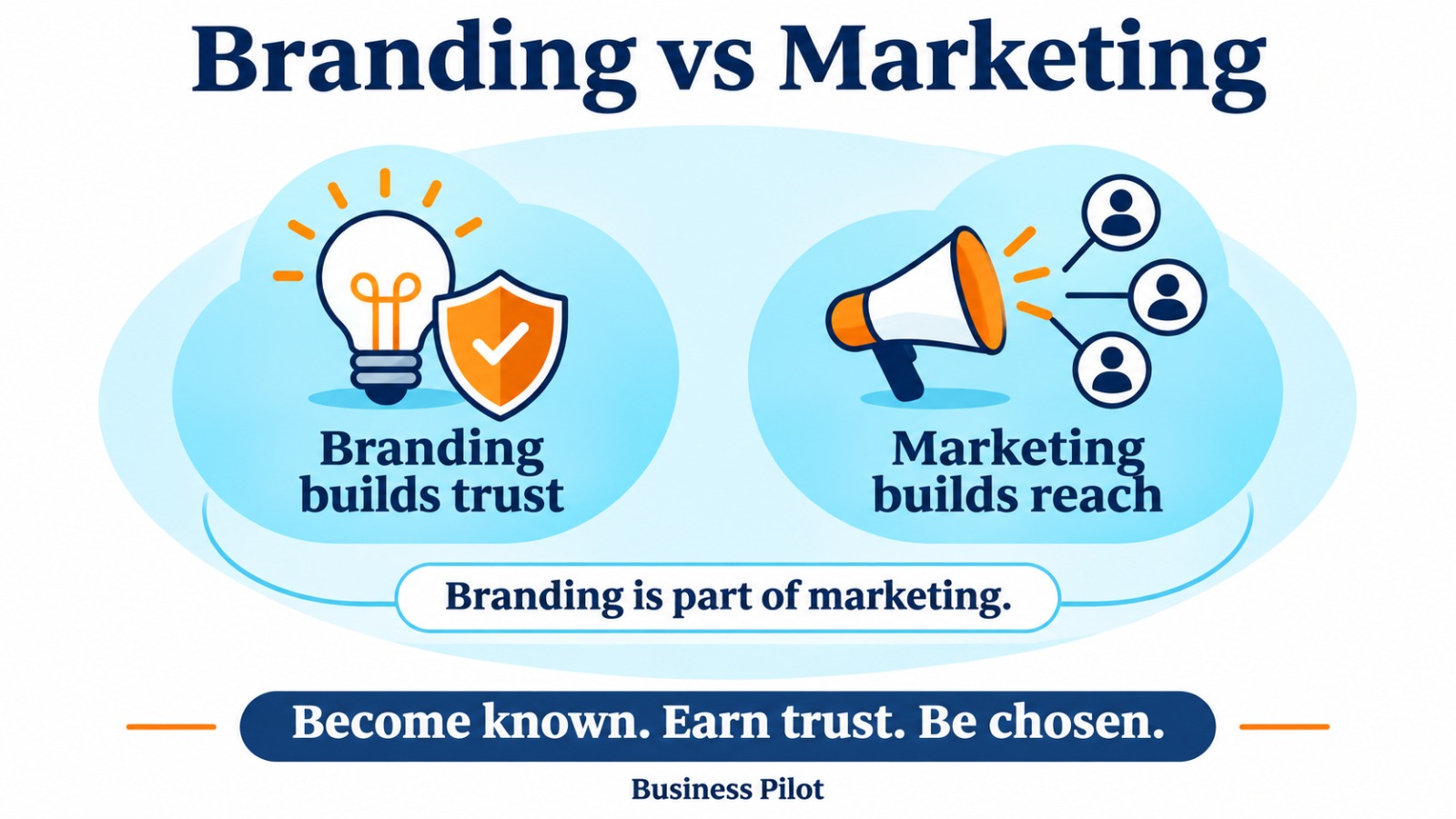
Brand builds trust, marketing spreads the word, ads buy attention, promotions create urgency, and sales closes the deal.
| Effort | What it does | Payoff | When you see it |
| Brand | Builds trust | People choose you without shopping around, refer others and accept your fees. You can often charge more. | Slow, but it lasts and compounds |
| Marketing | Spreads the word | The right people know you exist and remember you when they need you | Steady, weeks to months |
| Ads | Buy attention | Immediate visibility and inquiries | Fast, but stops when spending stops |
| Promotions | Create urgency | A quick push to act now | Instant and short-lived; overused, they cheapen you |
| Sales | Closes the deal | Inquiries become paying clients | Immediate, and it decides whether everything above was worth it |
The combined payoff: when all five work together, each tends to make the others cheaper. Trust helps ads convert, reputation reduces dependence on ad spend, and a strong front desk wastes fewer paid inquiries. Over time, that is the difference between a business that has to buy every client and one that attracts them.
A clinic with great ads but a weak front desk loses patients at the last step.
Frequently asked questions
What is the difference between marketing and advertising?
Marketing is everything you do to become known and chosen: your reputation, content, profiles and how you respond to inquiries.
Advertising is one part of it, paid space that puts your message in front of people. You can market without advertising, and for doctors and lawyers in India that is the main route.
Is digital marketing the same as branding?
No. Digital marketing is where you do the work: your website, Google, social media, email and WhatsApp. Branding is what that work builds in people’s minds.
An educational Instagram post is brand building; a paid Instagram ad for inquiries is advertising, on the same channel.
What is the difference between reputation management and branding?
Branding is the story you tell about yourself through your content, profile and the way you work. Reputation is the story others tell about you in reviews, listings and recommendations.
Reputation management means watching that story and responding to it: replying to reviews, fixing wrong details on listings and addressing the real problem behind a complaint.
What is the difference between brand awareness and marketing reach?
Reach is how many people saw your message. Awareness is how many of them now remember who you are and what you do.
You can buy reach with ads in a day. Awareness builds when people see a clear, consistent message from you more than once, and it only turns into clients when trust follows.
How long does branding take to show results?
There is no honest fixed date. Branding works in months, not weeks, and its results look different from ads: more people asking for you by name, more referrals and less pressure on your fees. Consistency matters most.
Can a marketing agency guarantee more clients?
No one can honestly guarantee how many clients or patients you will get, because that depends on your service, fees, reputation and how your team handles inquiries. A better question is what the agency will do, what it will measure and how it will report to you each month.
If you would like to talk through where your business stands on brand, marketing and sales, visit: Businesspilot
How this article was prepared: This article is based on Kumar Shankar Das Bahirwani’s own experience working with doctors, architects, professionals and MSME owners, and on the published sources listed below.
Sources
- National Medical Commission, Guidelines on Ethical Advertising and Public Communication, Public Notice R-13014/01/2024-Ethics, 6 October 2026 (full text, PDF)
- ICAI press release, 12 December 2025: Council approves amendments to Advertisement and Website Guidelines, new Code applicable from 1 April 2026
- Bar against legal advertising and solicitation, iPleaders
- Odisha Bar Council issues notices to advocates over social media promotion, UNI
- Google Ads Keyword Planner and AnswerThePublic (India, English), keyword research run on 2 November 2026
Leave a Reply