
Why this matters to you, even if you don’t run a restaurant
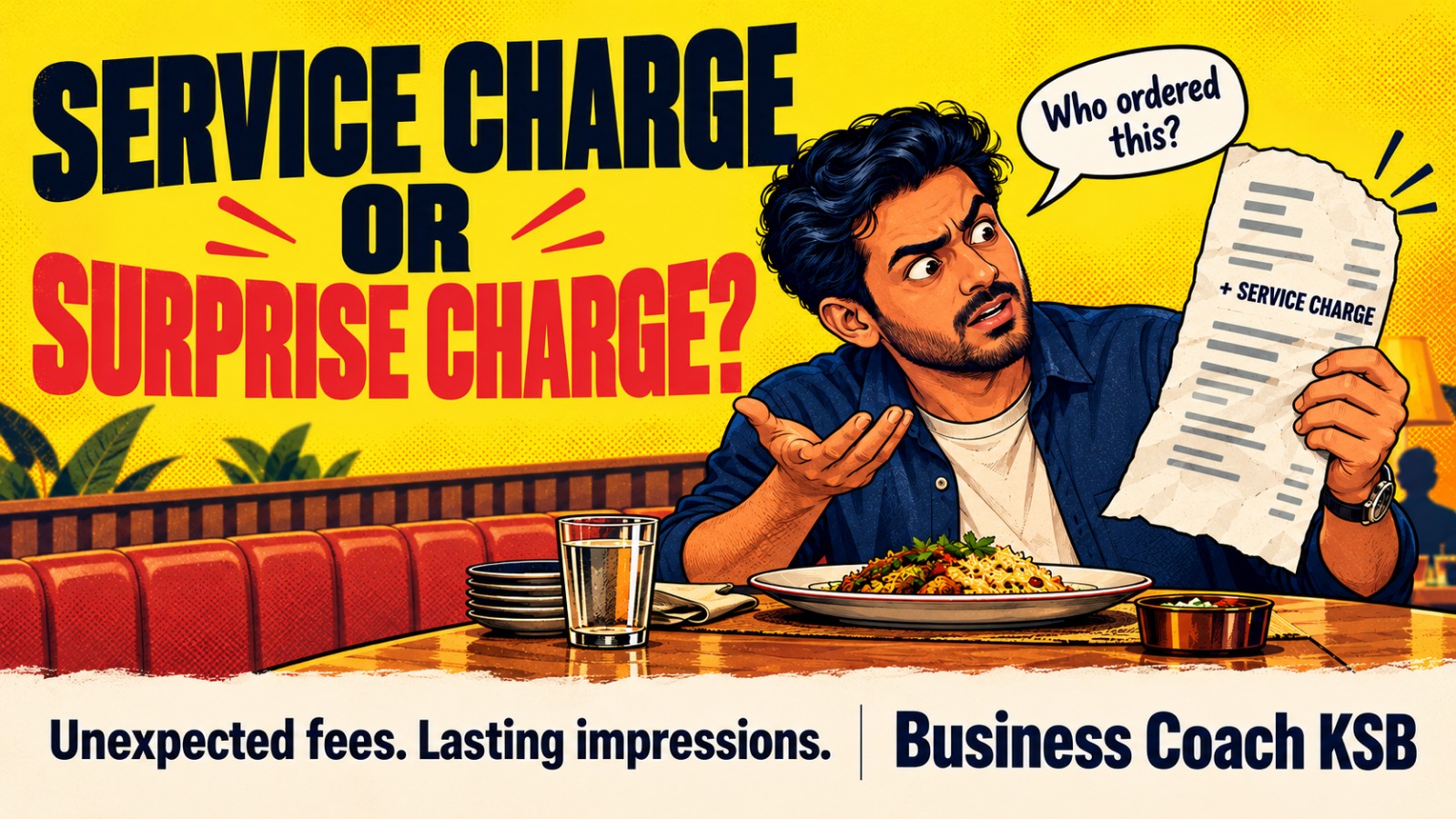
I have had this argument at restaurants more than once. Sometimes the staff insist that I pay, which is embarrassing in front of family and friends. Sometimes they make it emotional: the charge, they say, is for the welfare of the workers.
Even when they agree to take it off, you can feel the resistance. The face changes, the body language changes, and I am made to feel as if I have cheated them, or am underpaying them for what I ate. It is never done happily.
That is the side of this story the legal reports leave out. And the law is now firmly on the customer’s side.
In September 2026, the Gurugram District Consumer Commission ordered a restaurant, 21 Gun Salute, to refund a ₹116 service charge that a diner had asked it to remove. On top of the refund, it had to pay ₹20,000 in compensation and ₹11,000 in litigation costs (Outlook Money).
Two months earlier, in July 2026, the Central Consumer Protection Authority (CCPA) fined Chaayos ₹50,000 and ordered it to change its billing software. The reason was a service charge the chain called voluntary, but which its own system added to every bill.
Chaayos was not alone. The same announcement covered action against 41 restaurants. It also listed earlier final orders against brands like Barbeque Nation, China Gate (which runs Bora Bora in Mumbai) and Cafe Blue Bottle in Patna.
₹50,000 is small for a chain of more than 180 outlets. The real cost is the headline, the forced software change and what every customer who reads it now thinks.
Does your business add a service fee, convenience fee, handling fee, registration fee or platform fee on top of the price a customer sees first? Then this story is worth your time. The service charge rules cover hotels and restaurants, but the consumer protection law behind them applies to every business that sells to consumers.
Is service charge illegal in India?
A service charge is not illegal in itself, but forcing one is. Under the CCPA’s 2022 guidelines, upheld by the Delhi High Court in March 2025, a hotel or restaurant cannot add it automatically or collect it under another name. Nor can it refuse service if you decline. It must be voluntary, and GST cannot be charged on it as part of the food bill. You can ask for it to be removed.
What actually happened
Those guidelines date from 4 July 2022. For almost three years they were tied up in court.
On 28 March 2025, the Delhi High Court upheld these guidelines in National Restaurant Association of India v. Union of India (2025:DHC:2084). The court held that a service charge is a voluntary tip, that forcing it is an unfair trade practice, and that the guidelines are binding. The two restaurant associations were also ordered to pay ₹1 lakh each.
| Brand | What went wrong | What the CCPA ordered |
| Chaayos (Sunshine Teahouse), order of 14 July 2026 | Billing software added the charge to every bill until 1 May 2025. The restaurant told the customer it was mandatory under company policy. It did not resolve the complaint despite repeated follow-ups from the National Consumer Helpline, then renamed it “Optional Service Charge” | ₹50,000 penalty, refund to the customer, remove the default charge from the software, compliance report in 15 days |
| China Gate (Bora Bora, Mumbai), order of 29 December 2025 | A 10% charge added by default through billing software, with GST charged on top of it. The restaurant claimed it was taken only with consent | ₹50,000 penalty, change the billing software. Refunded during the hearing |
| Cafe Blue Bottle, Patna | 10% service charge added by default | ₹30,000 penalty, full refund, stop the practice |
| Barbeque Nation, order of 4 February 2026 | Added ₹335 to a bill in January 2025, then offered the refund only as credit on a future visit | Directed to stop service charges at all outlets. No penalty is reported: the charge fell under an interim court order at the time, the customer was refunded, and the chain stopped after the March 2025 ruling |
The restaurant associations have appealed to a Division Bench of the Delhi High Court. Until it rules otherwise, the guidelines stand.
Five lessons every business owner should take from these cases
1. Your software is your policy
Chaayos argued the charge was voluntary. The CCPA looked at the billing system and found the charge was built into the software. That ended the argument.
Whatever the menu or staff said, the CCPA judged Chaayos by what its billing system actually did. Apply the same test to your own. A pre-ticked box, a default fee in your POS, or an automatic checkout add-on is a decision you made. It counts whether you remember making it or not.
2. The price you show first is the price you owe
The CCPA’s core reasoning was about honesty in pricing. If you display a price and then add a mandatory charge at the end, you have hidden the real price from the customer.
This is the lesson that travels furthest, as good practice even where no specific rule applies. Put any fee the customer cannot avoid inside the price they see first, not on the last line of the bill.
3. A new label does not fix an old problem
After the complaint, Chaayos renamed its charge “Optional Service Charge”. The investigation found that this did not cure the earlier violation. The guidelines also bar collecting the charge under any other name.
If you are tempted to rename a fee to “staff contribution”, “convenience fee” or “platform fee” while keeping it compulsory, don’t. In the Chaayos case, the CCPA looked at what the customer was made to pay, not at what the charge was called.
4. How you handle one complaint decides how big the case gets
The Chaayos and Barbeque Nation cases each began with one complaint to the National Consumer Helpline. Barbeque Nation refunded the ₹335 and stopped the charge; no penalty is reported. Chaayos left the complaint unresolved until the CCPA stepped in, and the CCPA weighed that in its penalty.
Refund in full, in money, not as a voucher for next time. How you take the charge off matters as much as whether you do. A customer who has to argue at the table, or who gets a cold look while the line is removed, remembers that, not the food. And that customer does not need the CCPA: the Gurugram diner went straight to the district consumer commission.
5. Don’t build your business on a charge you might lose
In court, the restaurant associations argued that the service charge supports staff pay. Once it is optional, that money is no longer certain. The same risk applies to any business whose margin depends on a fee customers dislike and regulators are questioning.
If a charge is genuinely part of your cost, build it into your price. If you want to reward staff, do it through wages and incentives you control, and let tips stay what the law says they are: voluntary.
Not a restaurant? The same logic still reaches you
The 2022 service charge guidelines are written for hotels and restaurants. The principle behind them is broader. A customer’s right to be told the price, and to be protected from unfair trade practices, comes from the Consumer Protection Act, 2019, which covers businesses selling to consumers.
For online sales, the CCPA’s Dark Patterns Guidelines, 2023 go further. They ban drip pricing (revealing parts of the price late) and basket sneaking (adding charges at checkout without consent).
Not every extra fee is illegal
The service charge rules do not make every separate fee unlawful. An agreed event management fee, a courier’s disclosed handling fee or a clearly stated booking fee can be legitimate. The problem is a charge that is hidden, added by default, or simply a markup on the same service under a new name.
Three questions sort one from the other:
- Did the customer see the fee before deciding to buy?
- Did the customer agree to it, rather than discover it on the final bill?
- Does it pay for something genuinely separate from the service they already bought?
The restaurant guidelines do not cover these fees. Still, a fee that fails any of these questions invites the same kind of complaint under the Consumer Protection Act.
Where to look in other businesses. This is good practice, not a list of illegal fees:
| Business | Charge to look at | The safer approach |
| Clinics and hospitals | Registration, file or “admin” fees added at the counter | Publish consultation and procedure fees with every compulsory fee included |
| Hotels, banquet halls and caterers | Service charge on room service or F&B; staff, setup or coordination charges added to the final event bill | Quote all-inclusive package prices in the contract; keep tips optional |
| Salons, spas and gyms | “Service fee”, “staff contribution” or “maintenance charge” added to the menu price | Put the final price on the rate card |
| Automobile service centres | Consumables, documentation or workshop charges not in the estimate | Give a written estimate listing every charge before work starts |
| Coaching, schools and fitness programmes | Registration, admission or facility fees missing from the advertised fee | Advertise the total cost a student or member actually pays |
| Events and ticketing | Booking or convenience fees revealed at the last step | Show the full ticket price from the first screen |
| E-commerce and D2C brands | Packaging, handling or COD fees added at checkout; pre-ticked add-ons | Show all fees on the product page; no pre-ticked boxes |
| SaaS and subscriptions | “Platform fee” added after the plan price; auto-added add-ons | Price plans with every compulsory fee included |
| Cafes, cloud kitchens and delivery | Packaging or service charges added by default on the POS | Remove POS defaults; include packaging in the item price |
Run every charge in your own business through the three questions above.
Your compliance checklist for this week
Most of these are quick. Do them before a customer complaint does them for you.
Pricing and bills
- Print three real bills or invoices from last week and run every extra line through the three questions above
- Move every compulsory charge into the displayed price on your menu, rate card, website or quote
- Restaurants and hotels: do not add a service charge to the food bill and charge GST on the total (CCPA guidelines, para 7(v)). Other businesses: ask your GST adviser how any optional amount should appear on the invoice
Systems
- Open your POS, billing software or checkout settings and switch off any charge that is added by default
- Ask your software vendor in writing to confirm no charge is applied automatically, and keep the reply
Words and signage
- Check that your menu, website and counter signage do not describe any optional amount as compulsory, or any compulsory amount as optional
- If you accept tips, say clearly that they are voluntary, and ask before adding anything
People and complaints
- Brief front-desk, billing and cashier staff on one line: “If a customer asks to remove it, remove it, politely and without argument”
- Set a rule that refunds for disputed charges are paid back in money within a set number of days, not given as credit for a future visit
- Name one person who replies to every National Consumer Helpline or regulator notice within 48 hours
Records
- Keep a dated note of the changes you made and when; if a complaint comes later, this shows you acted in good faith
Transparency is the cheaper strategy
The fix costs very little: one honest price, software that does what your policy says, and staff who remove a disputed charge without a fight. In return, customers never feel tricked at the counter, and that trust is worth more than any add-on fee.
If you run a business that adds anything to the price your customer sees first, use the checklist above this week. Then make the honest price part of how you sell.
Frequently asked questions
Is service charge mandatory in restaurants?
No. Under the CCPA’s 2022 guidelines, a service charge in a hotel or restaurant is voluntary and at the customer’s discretion.
A restaurant cannot add it by default, and cannot make paying it a condition of entry or service. The Delhi High Court upheld these guidelines in March 2025.
Can I ask for service charge to be removed from the bill?
Yes. You can ask for a service charge to be removed before you pay, and the restaurant should take it off.
The guidelines also bar restaurants from restricting entry or service because you decline to pay it. If staff still refuse, use the complaint options in the last question below.
Is service charge the same as a tip?
In law, yes. The Delhi High Court described a service charge as what people commonly call a tip: a voluntary payment by the customer.
The menu price already covers the service. Like any tip, you decide whether to give it and how much.
Is GST applicable on service charge?
The CCPA guidelines say a service charge cannot be added to the food bill with GST levied on the total.
In the China Gate case, adding a default 10% charge and charging GST on it was part of what the CCPA penalised. For the tax treatment of a genuinely voluntary tip, check with your GST adviser.
Do these rules apply to hotels too?
Yes. The 2022 guidelines cover both hotels and restaurants, so hotel F&B and room-service bills follow the same rule.
Businesses outside hotels and restaurants are not covered by these guidelines, but the Consumer Protection Act, 2019 still bars unfair trade practices.
Where can I complain about a forced service charge?
Call the National Consumer Helpline on 1915, or use its app or website. The CCPA has taken up cases that began as helpline complaints, including Chaayos and Barbeque Nation.
You can also file directly with your district consumer commission for a refund and compensation, as the Gurugram diner did.
This article is for general business guidance and is not legal advice. The Delhi High Court’s March 2025 ruling is under appeal before a Division Bench; check the current position, and speak to a lawyer about your specific charges.
Sources
- CCPA: Guidelines on levy of service charge in hotels and restaurants, 4 July 2022 (official PDF)
- Verdictum: Delhi High Court judgment, NRAI v. Union of India, 2025:DHC:2084
- SCC Times: CCPA order against Chaayos, 14 July 2026
- Outlook Money: Gurugram commission order on a ₹116 service charge, 16 September 2026
- LiveLaw: CCPA fines China Gate over Bora Bora, Mumbai
- Outlook Business: CCPA order against Barbeque Nation
- Moneylife: CCPA orders against Cafe Blue Bottle and China Gate
- Moneylife: CCPA action against 41 restaurants
- NewKerala: List of restaurants in the July 2026 action
- Storyboard18: Division Bench hearing on the appeal
- AZB & Partners: CCPA Dark Patterns Guidelines, 2023