
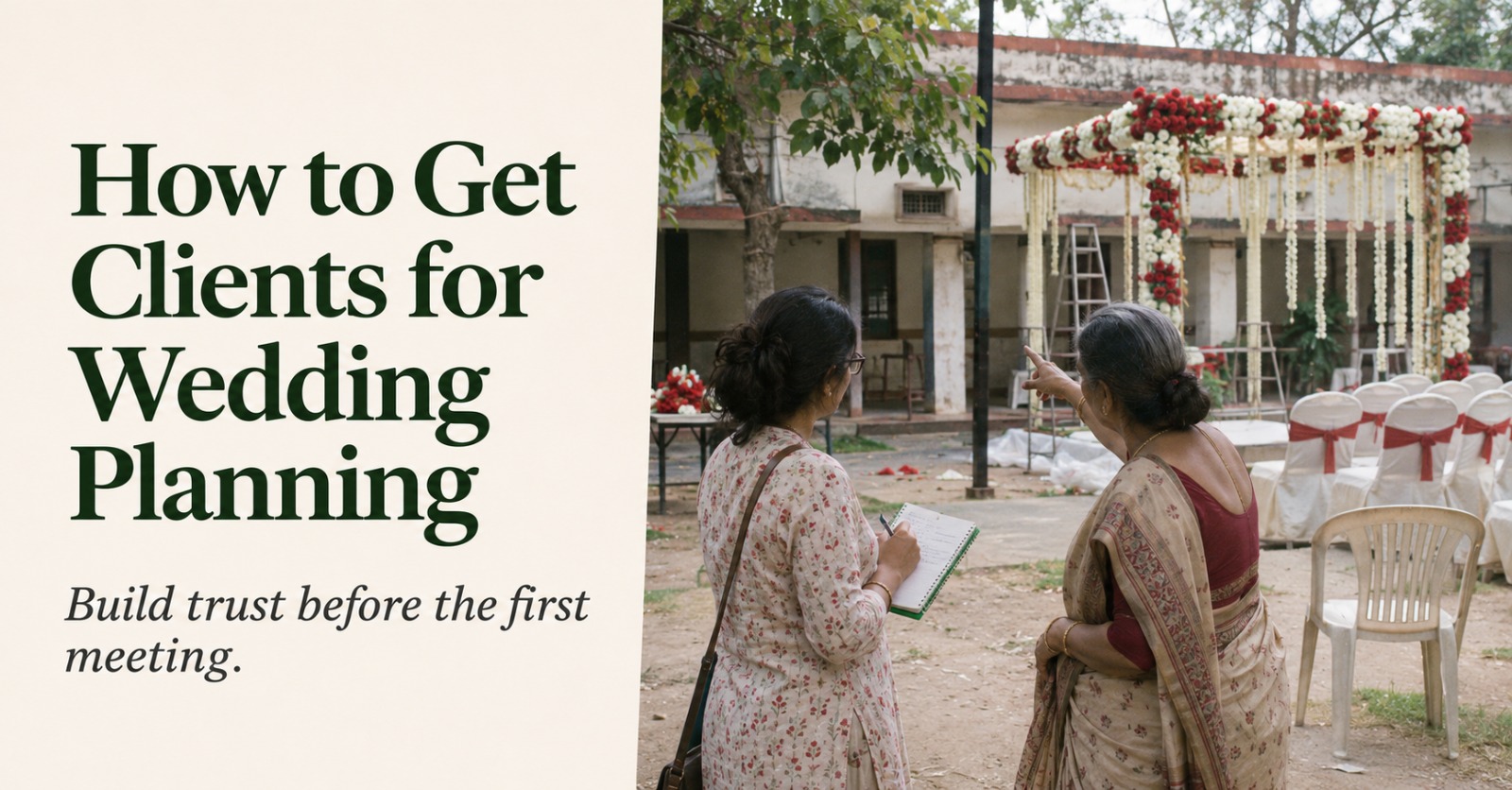
Most wedding planners treat their online presence as a way to get found. But a family doesn’t book the planner it finds. It books the planner it trusts. That gap is what this article is about, and closing it is how to get clients for wedding planning without depending only on referrals.
Wedding season opens with Dev Uthani Ekadashi on 20 November 2026. Many planners have a Google Business Profile and a website, and leave it at that. Their Instagram is full of décor, stages and happy couples.
For most of them, referrals are still the strongest source of bookings. The family that calls usually heard about them from a relative, a friend, or a guest at a wedding they handled. Very few planners work seriously on being found online, and fewer still on being trusted there.
The mistake: thinking online is about getting found
Wedding planners understand that digital presence matters. That is not the problem. The problem is the lens they look through.
They see the website, the Google profile and Instagram as marketing tools. The questions they ask are marketing questions:
- How do I come up when someone searches “wedding planner near me”?
- How do I get more followers?
- How do I get more enquiries?
If you have ever searched “wedding planner marketing” or “how to get clients for wedding planning”, you have been asking these questions too. They are not wrong. But they only solve half the problem. Getting found brings a family to your page. It does not make them hand you their daughter’s wedding.
That second step is trust. And very few wedding planners build their online presence for trust.
Why trust is the real job
A wedding is one of the most important events in a person’s life. In an Indian family, it is often the most important event the whole family will host for years. Savings, reputation in the community, elders’ expectations and the couple’s dreams all sit on that one day, or those three or five days.
Now think about what a family is doing when it hires a wedding planner. It is handing that entire event to an outsider. Someone who is not family. Someone they may have met once or twice.
That takes a huge amount of trust. A family can find you through search in ten seconds. Deciding to trust you takes much longer, and it is decided on very different things.
This is not only true of grand weddings. Close-knit families with fewer guests hire wedding planners too. They want to relax and enjoy the wedding, not spend it worrying whether everything is in place. The biggest weddings may be in North India, but this need exists across the whole country.
Why references work, and how to carry that online
This is why wedding planners depend so heavily on word of mouth. A reference is not just a phone number passed along. It carries proof with it:
- “They understood our customs.”
- “They handled everything, we didn’t have to run around.”
- “When something went wrong, they fixed it before anyone noticed.”
That is what a family is really buying. A reference works because it answers the trust question before the first meeting.
Your online presence can do the same job. Not by saying “we are the best wedding planners in the city”. Every planner says that. It works by showing the same proof a happy family would talk about. Two kinds of proof matter most.
What families actually search before they call you
I looked at what people in India type into Google about wedding planners. The pattern is clear. Planners search for marketing. Families search for a planner, and then check whether they can trust one.
What families actually search before they call you
I looked at what people in India type into Google about wedding planners. The pattern is clear. Planners search for marketing. Families search for a planner, and then check whether they can trust one.
| What families search | Avg. monthly searches (India) |
| wedding planner near me | 1,000 to 10,000 |
| wedding planner reviews | 100 to 1,000 |
| wedding planner portfolio | 100 to 1,000 |
| wedding planner for indian wedding | 100 to 1,000 |
| questions to ask wedding planner before hiring | 10 to 100 |
| how to choose a wedding planner | 10 to 100 |
| punjabi, marwari, south indian wedding planner | 10 to 100 each |
| wedding planner scam | 10 to 100 |
Source: Google Keyword Planner (search volume and forecasts), India, all languages, November 2025 to October 2026. Keyword Planner shows these as ranges, not exact figures.
“Near me” is how a family finds planners. Look at the rest. Reviews. Portfolio. Questions to ask before hiring. A planner for our community. Scams. Once a family has a few names, these are the searches it uses to decide which planner it can trust.
Now look at what planners search: “wedding planner marketing”, “wedding planner Instagram bio”, “how to get clients for wedding planning”. None of the planner searches I checked was about trust. That gap is your opportunity.
Proof 1: show you understand local rituals and customs
No two Indian weddings are the same. A Punjabi family will expect the Jaago. A Gujarati family will care about the Mameru. A Tamil or Telugu family may want the Kashi Yatra done properly. Even within one community, customs change from district to district and family to family.
A family’s biggest fear is that an outsider will get these things wrong in front of the elders and the whole community.
So show them you won’t. Write about the rituals common in the areas you work in. Explain the order of ceremonies, what each one needs, and what usually gets missed. If you work with a community you know less about, show that you research well. Sit with the family’s elders, ask the pandit, and plan around their traditions rather than your template.
A family that reads this before calling you is already halfway to trusting you.
Proof 2: show you can handle the last-minute emergency
Every Indian wedding has its moments when things go wrong. The whole rhythm of the day goes for a toss. Breakfast happens at lunchtime and lunch at evening tea. There is a lot of eating, drinking, dancing and waiting. At destination weddings, guests have travelled, and family members are tired and busy. The chances of someone falling sick are high.
At one wedding I attended, the bride’s father fell ill a few hours before the ceremony. We had to put him in a cab, find a local hospital, get him admitted and put on a drip, and get him emergency medicine. Back at the hotel, everyone was in full tension. A handy person who had already thought about medical emergencies would have made a huge difference that day.
Not every emergency can be prepared for. But a planner who has thought about them knows the nearest hospital and has a doctor’s number ready. Transport is on standby, and one person is free to go with the family.
Families know this. What they are quietly asking is: “When it happens at our wedding, will this person stay calm and fix it?”
Most planners only post the finished décor. That shows taste. It doesn’t show reliability. Talk about the backup plans you keep ready. Describe, with the family’s permission, a real problem you solved on the day and how you solved it. Show your checklists and your team on the ground.
This is the content that makes a family feel safe. Beautiful photos make them like you. Proof that you can handle a crisis makes them trust you.
How to get clients for wedding planning: what to change this season
You don’t need new platforms. You need to use the ones you have for trust, not just for visibility.
| Platform | Built for getting found | Built for trust |
| Google Business Profile | Right category, location, photos of décor | Honest reviews from every family; a reply to every review; posts on ritual planning |
| Website | A services page and a contact form | A page for each community or region you serve, explaining its rituals; a page on how you handle emergencies and backups |
| Stage and décor reels | Behind-the-scenes on the wedding day; short explainers on rituals; a real “what went wrong and how we fixed it” story | |
| Reviews and testimonials | Star rating | Families describing in their own words why they trusted you |
One practical step for this week: ask every family you work with for an honest review, not only the happiest ones. Don’t tell them what to write. If they ask, say: “Whatever stood out to you, in your own words.” Genuine, specific reviews do more for your brand than any “best service, highly recommended” line.
Content that builds trust before the first meeting
- Write about every wedding, with the family’s consent. Photos go in an album. The story of holding the wedding goes in an article. Even for the same community, every wedding is different, and the more you write, the more relatable you become.
- Ask every family for an honest review, in their own words. Genuine reviews show future clients what to expect, including the things you did that nobody expected of you.
- Use educational content to set boundaries. Explain what you handle and what you need from the family. Clients arrive knowing what is expected of them.
- Make reels that go beyond décor. Explain why you did what you did, how it added value to the wedding, and how the guests reacted.
- Give advice to families planning without a planner. Some want to do it themselves; some have no budget for a planner. Helping them anyway is one of the strongest trust signals you can send.
Frequently asked questions
What makes a great wedding planner?
Good taste and good vendors are expected. What makes a planner great is trust. The family can hand them the whole event because they understand the family’s customs and plan for things going wrong.
When something does go wrong, a great planner stays calm and fixes it.
How do I get clients for wedding planning?
Most wedding planners get their best clients through references. To get more clients online, make your website, Google profile and Instagram do what a reference does.
Show your understanding of local customs, real reviews from families, and how you handle problems on the day.
What are common wedding planning mistakes?
Getting a ritual or its order wrong, having no backup when a vendor or the weather lets you down, and poor communication with the elders of the family.
A planner who writes openly about how they avoid these builds trust before the first meeting.
Is digital marketing enough for a wedding planner?
It gets you found, which matters. But a family hands over a wedding only when it trusts you. Digital marketing without trust-building brings enquiries that don’t convert.
Pair visibility with proof: honest reviews from families, stories of problems you solved, and content that shows how you work.
Brand builds trust, marketing spreads the word
Marketing gets your name in front of a family. Your brand is what makes them pick up the phone and hand you the most important event of their lives.
Word of mouth will always matter in this business. But you can’t control who talks about you, or when. What you can control is what a family finds when they look you up.
Make sure what they find is proof that you understand their traditions and won’t let them down on the day. That is how to get clients for wedding planning who arrive already trusting you.
At Business Pilot, we don’t only help you get found organically. We make sure a degree of trust is built before a family ever meets you, while they are looking you up.
We help you write about the weddings you plan, with your clients’ consent. Not just the photographs everyone puts in an album, but the whole experience of holding that wedding.
We help you turn reviews, reels and educational content into proof that you can be trusted with a family’s biggest day.
If you’re a wedding planner, start with a free online trust audit. I’ll show you what a family sees when they look you up, and what would make them trust you before they call.
Message me on WhatsApp for your free trust audit
Sources
- Google Keyword Planner: search volume data, India, November 2025 to October 2026.
Leave a Reply