
Author: businesspiloteditor

  • Local SEO for Doctors: How to Rank Across Different Parts of Your City

    Local SEO for Doctors: How to Rank Across Different Parts of Your City

    A dermatologist based in one part of a city may rank strongly on Google Maps nearby. Yet the same clinic can become much less visible when a patient searches from another part of the same city. The clinic has not changed. The doctor’s expertise has not changed. What has changed is where the patient is standing when they search.

    This is one of the most common questions doctors ask about local SEO for doctors: “We show up near the clinic, so why don’t we show up across town?”

    The short answer is that Google uses two different systems to show clinics to patients, and each one responds to geography differently.

    Understanding both helps you invest effort realistically, and avoid tactics that can get a Google Business Profile suspended.

    What we see at Business Pilot: most doctors check their visibility by sitting in the clinic and searching “best [specialty] near me”. The clinic ranks well, so they assume their SEO is working. But that search runs from the one spot where the clinic is strongest, often a small locality around it.

    Many doctors we speak with do not realise that results change with where the patient searches from, and with the exact words they use. Learning that a prospective patient elsewhere may not find the clinic in the top 10 at all often comes as a shock.

    Why doctors want to rank beyond their immediate locality

    Patients will travel for the right doctor. For planned care, such as IVF, orthodontics or a second opinion before surgery, many patients will cross the city to see a specialist they trust. For routine or urgent needs, most people simply choose someone close by.

    So a specialist’s real catchment is often much wider than the streets around the clinic. But Google’s map results are built around proximity, and a single clinic address has a natural limit to how far it reaches.

    How patients actually search: city, locality and “near me”

    Patients do not all search the same way. Their searches fall into three geographic levels, and each behaves differently.

    1. City level: “dermatologist in [city]” or “best dermatologist in [city]”. The patient names the whole city, but Google can still factor in where they are searching from.
    2. Locality level: “dermatologist in [locality]” or “best dermatologist in [locality]”. The patient names an area, which may or may not be where they are right now.
    3. Proximity level: “dermatologist near me” or “best dermatologist near me”. Google leans heavily on the searcher’s current location.

    So “ranking in the city” is not one position. It is many positions, depending on who is searching, from where, and with which words. A clinic can be first for one patient and invisible to another a few kilometres away.

    Why one Google Business Profile cannot dominate an entire city

    Can one Google Business Profile rank equally across a whole city? Usually not. A profile is tied to one verified clinic address, and distance from the searcher is one of Google’s core local ranking factors.

    A strong profile can rank well near the clinic and hold its visibility some distance beyond it. In a large, competitive city, though, its performance usually weakens as the searcher moves farther away.

    A strong Google Business Profile can expand its visibility radius, but it cannot eliminate geography.

    Relevance, distance and prominence in plain English

    Google states that local results are mainly based on three factors: relevance, distance and prominence. Here is what each one means for a clinic.

    Relevance: does your profile match what the patient searched for?

    Relevance is how well your profile matches the search. Your primary category (for example, “Dermatologist”), the services you list, your business description and the treatment content on your website all tell Google what you do. A sparse profile gives Google less information to understand which searches your clinic is relevant for.

    Distance: how far is the clinic from the patient?

    Distance is how far your clinic is from the searcher, or from the location named in the search. For an existing clinic, this is the one factor you cannot change. You can only influence it by opening a genuine new location.

    Prominence: how well known is the clinic?

    Prominence is how well known your practice is, online and offline. Google says review count and rating, links and mentions from across the web, and your position in regular web results all contribute. This is where sustained, genuine effort pays off.

    Google also states there is no way to request or pay for a better local ranking. Ads can appear above map results, but they are labelled as ads and are a separate system.

    The practical takeaway is simple. You control relevance and prominence. Distance is fixed for each real address you have.

    How far can a clinic realistically rank on Google Maps?

    Google Maps ranking for doctors has no fixed radius, and Google does not publish one. Anyone quoting a universal figure such as “3 km” or “5 km” is guessing. In practice, how far a clinic’s map visibility reaches depends on several things:

    • Competition: how many similar clinics sit between you and the searcher.
    • Specialty: a less common super-specialty usually has fewer nearby competitors than, say, general dentistry, so its visibility can stretch farther.
    • City density: clinics in crowded central areas usually face a sharper drop-off than those in less saturated areas.
    • Search intent: “near me” searches are more distance-sensitive than searches for a specific treatment.
    • Profile strength: Google confirms reviews feed prominence. In practice, complete and active profiles tend to hold up better as distance grows, though Google does not document this.
    • Local authority: mentions, links and citations that connect your clinic to the wider city.

    To see your real reach, don’t rely on searches from your own phone, which are personalised. Geo-grid rank tracking tools check your position from many points around the clinic. Your profile’s performance reports also show which searches found you.

    Google Maps ranking vs organic Google ranking

    Doctors asking how to rank a clinic on Google are really asking about two visibility systems on the same results page.

    Aspect Google Maps / Local Pack Organic Google search
    What appears Your Google Business Profile, with map pin, reviews and directions Pages from your website, such as treatment pages and articles
    Influence of geography Very strong; tied to one address per location Present, but less tightly tied to one map pin
    What you build Profile completeness, categories, reviews, photos, posts Useful pages, site authority, internal links, citations, backlinks
    Realistic reach Strongest around each clinic location Can extend across the city and beyond for the right topics


    Can a clinic rank outside its area on Google?

    In organic search, often yes. This is where broader doctor SEO does its work. A well-built treatment page can rank for searches such as “acne scar treatment in [city]” or a common patient question, well beyond the clinic’s immediate locality.

    Ranking outside your physical area is generally far more achievable in organic search than in the map results.

    The same qualities help with AI search. Clear answers, verifiable information and consistent clinic details make these pages easier for Google and AI search tools to interpret and use.

    How doctors can expand visibility beyond their immediate area

    Good medical local SEO is not about tricking Google into ignoring distance. It is about making your clinic genuinely relevant and prominent, and building pages that rank where your map pin cannot.

    Strengthen your Google Business Profile

    Choose the most accurate primary category, list the treatments you actually offer, and keep hours, phone number and photos current. Ask satisfied patients for honest reviews as a routine, and reply to them professionally. Do not add keywords or locality names to your business name. Google’s guidelines prohibit it, and it puts the profile at risk.

    Build treatment and service pages that deserve to rank

    Create one clear page for each important treatment, explained in plain language, reviewed by the doctor, and answering the questions patients actually ask. These pages carry your organic visibility across the city.

    Publish useful content around real patient questions

    Articles that answer genuine questions (“Is laser hair removal safe for darker skin?”) can attract patients from anywhere in the city, and give AI search tools something credible to cite.

    Keep clinic details consistent everywhere

    Your clinic name, address and phone number should match exactly across your website, your profile and Indian healthcare listing platforms such as Practo and Justdial. Inconsistent details weaken the signals that connect your clinic to its location.

    Earn local mentions and links

    Hospital affiliations, medical association listings, local news features and health talks create genuine references to your clinic from across the city.

    Link your pages together and add structured data

    Link treatment pages to related articles and to your contact or location page. Add structured data, such as Physician, MedicalClinic or LocalBusiness schema, so search engines and AI tools can read your clinic details reliably.

    When location pages make sense for doctors

    Location pages can help organic local SEO when they are genuinely useful to patients from that area. They make sense when:

    • Your appointment records show a meaningful number of patients coming from that locality.
    • You have something specific and true to say to those patients, such as travel routes, parking or accessibility details.
    • The page would help a patient from that area decide whether and how to visit you.

    They do not make sense when the only purpose is to repeat the same copy with a different area name. Pages such as “Dermatologist in Area A”, “Dermatologist in Area B” and “Dermatologist in Area C”, built mainly to capture searches and funnel patients to the same clinic with little unique value, can fall within what Google’s spam policies describe as doorway abuse. At best they are ignored. At worst they weaken trust in the whole website.

    What a good locality page should contain

    A useful locality page contains information a patient from that area would actually value:

    • Treatment availability: the treatments patients from that area most often come in for.
    • Clinic accessibility: parking, lift access, wheelchair access and nearby landmarks.
    • Neighbourhoods commonly served: stated honestly, based on where patients really come from.
    • Directions and travel context: routes, metro or bus connections and typical travel considerations.
    • Locally relevant FAQs: real questions patients from that area ask the front desk.
    • Doctor expertise: who the patient will see and what they specialise in.
    • Patient concerns: issues that genuinely matter to that patient group.
    • Original information: anything that could only have been written by your clinic.

    A quick test: remove the locality name from the page. If what remains could apply to any area of any city, the page is not ready to publish.

    What not to do

    Some tactics promise wider map visibility but break Google’s guidelines. The risk is suspension of your profile, which can remove the clinic from the map entirely while you go through reinstatement.

    • Fake addresses or virtual offices: Google’s guidelines say a rented address you do not operate from is not eligible for a Business Profile.
    • O. boxes or remote mailboxes: these are not acceptable business addresses.
    • Duplicate profiles for the same location: one location should have one profile.
    • Keyword-stuffed business names: “Dr. X Best Skin Clinic [Locality]” instead of your real name.
    • Fake, bought or incentivised reviews: these breach Google’s policies and can damage patient trust if discovered.

    What changes if the clinic has multiple genuine branches

    If your practice has more than one genuine, staffed physical location that patients can visit during stated hours, each branch can have its own properly verified Google Business Profile. Each branch then competes in its own local area, which is the legitimate way to extend map visibility across a large city.

    Each branch should also have its own page on your website, with that branch’s address, timings, doctors, services and directions. Link each profile to its matching branch page rather than to your home page.

    Google’s guidelines also allow individual doctors in public-facing roles to have their own profile at the location where they practise. This needs careful setup so it does not duplicate the clinic’s own profile.

    A practical city-wide local SEO plan for doctors

    1. Map where your patients come from. Use appointment records to see which localities your patients travel from, and for which treatments.
    2. Measure your current reach. Run a geo-grid check to see where your map visibility is strong and where it fades.
    3. Fix your profile fundamentals. Category, services, description, hours, photos and a steady, honest review routine.
    4. Build pages for your priority treatments. Start with the treatments you most want to be known for.
    5. Add locality pages only where the data supports them. Use step one to decide which areas deserve a page, and write each one with real local detail.
    6. Build prominence steadily. Consistent listings, local mentions, genuine links and ongoing reviews.
    7. Review every quarter. Compare geo-grid results, profile insights and website traffic, then adjust.

    Frequently asked questions


    What is local SEO for doctors?

    Local SEO for doctors helps patients near you find your clinic on Google Maps, in regular Google search and in AI search tools.

    It covers your Google Business Profile, treatment and location pages, reviews, consistent listings and local mentions across the city.

    How do I rank as a doctor on Google Maps outside my area?

    On the map, only to a limited extent. Your profile is tied to your clinic address, and distance is one of Google’s main local ranking factors, so visibility usually weakens farther away.

    Organic website pages are the more realistic way to reach patients in other parts of the city.

    How do I rank my clinic on Google Maps in multiple locations?

    Only a genuine, staffed physical location can have its own Google Business Profile.

    If you run real branches, verify a profile for each and link it to a matching branch page. With one clinic, strengthen that profile and build pages that rank organically across the city.

    Should I create separate website pages for each area of my city?

    Only where they genuinely help patients from that area, with real local details such as directions, accessibility, commonly served neighbourhoods and local questions.

    Near-identical pages that only swap the area name can fall within what Google treats as doorway abuse, and are best avoided.

    Can I use a virtual office to rank in another area?

    No. Google’s guidelines say a rented address your practice does not operate from is not eligible for a Business Profile, and using one risks suspension.

    The legitimate routes are a genuine new branch or stronger website pages for that area.

    How long does local SEO take for a clinic?

    There is no fixed timeline. Profile corrections can show fairly quickly, while prominence from reviews, content and local links builds over months.

    It depends on your specialty, local competition and starting point. Be cautious of anyone who guarantees rankings or patient numbers.


  • Digital Marketing Agency for Doctors: What to Look For

    Digital Marketing Agency for Doctors: What to Look For

    Digital Marketing Agency for Doctors: What to Look For

    What does a digital marketing agency for doctors actually do?

    A digital marketing agency for doctors manages a clinic’s online visibility so patients can find, trust and book with the right doctor. That covers the website, Google Business Profile, local SEO, patient education content, reviews, and sometimes paid ads and social media.

    The part that separates a genuinely useful agency from a busy-looking one is simple: does the work turn into more patients calling and booking, or does it just turn into more posts and a better looking dashboard?

    A search for healthcare digital marketers turns up dozens of options that all sound similar on paper. For a doctor who has never hired a marketing partner before, or who has hired one and been disappointed, the real decision comes down to that one question above, not to how polished the pitch sounds.

    Why this decision is worth getting right

    A wrong hire here is not just a wasted retainer. For a solo practice, it usually means a few months of content nobody reads and a website that still does not explain what makes the doctor different.

    For a clinic or small hospital, the cost is bigger. These practices have often already invested in beds, diagnostic equipment or a specialist team, and that investment carries a fixed monthly cost whether the appointment slots are full or empty.

    An agency that cannot turn visibility into booked patients is not a marketing problem at that point. It is a direct drain on capacity that has already been paid for.

    Why doctors approach this decision cautiously

    Before a doctor agrees to work with us, four concerns come up almost every time, and they are worth naming honestly rather than glossing over.

    Time is the first one. A doctor’s day is already full with patients, and a marketing engagement that demands hours of the doctor’s own attention each week is not realistic, however good the strategy behind it.

    The second is understanding. Most doctors have not been trained in social media or digital marketing, so when an agency hands over a report full of impressions, reach and engagement rates, there is no easy way to tell whether that is genuinely good work or just activity dressed up to look like progress.

    The third is the camera. A large part of modern content marketing leans on video, and most of the doctors we have worked with are simply not comfortable being filmed regularly. An agency that treats video as mandatory rather than optional rules itself out for a lot of doctors before the conversation even starts.

    The fourth is the most costly one: many doctors have already hired a digital marketing company once. They paid for a set number of months, watched the follower count or the keyword ranking move a little, and ended the contract with the same number of patients they started with. That experience makes the next hiring decision a lot more guarded, and rightly so.

    What a good marketing partner should actually deliver

    None of the four concerns above are solved by a better sales pitch. They are solved by how the agency actually works. When doctors ask us what the best digital marketing agency for doctors looks like in practice, the answer is not a list of services. It is a list of behaviours the agency should be able to show, not just claim.

    – It should work around the doctor’s schedule rather than asking for large blocks of the doctor’s time every week. Reviews and sign-offs should take minutes, not meetings.

    – It should be able to explain its plan and its reporting in plain language, without requiring the doctor to already understand digital marketing to judge whether the work is any good.

    – It should never make video, or being on camera, a condition of the engagement. There are credible ways to build authority in writing, in Google Business Profile posts, and in patient education content that do not require a doctor to perform on camera.

    – It should be willing to be judged on the same terms every time: not on views, followers or ranking position on their own, but on whether more of the right patients are actually calling, messaging or booking.

    – And it should set a defined point to review progress against, agreed before work starts, not left open-ended. What counts as an early positive signal, and when you will sit down and look at it together, should be explicit before you sign, not negotiated after the fact.

    Questions worth asking before you sign

    A short conversation before signing tells you more than any pitch deck.

    – Ask how the agency defines success, and get the answer in terms of patients, not metrics. “More visibility” is not an answer. “More calls and bookings, tracked from where they came from” is.

    – Ask what the doctor will actually be asked to do each month. If the honest answer is more than approving a few pieces of content, that is worth knowing before you start, not after.

    – Ask what happens to clinical content before it goes live. A responsible agency should have the doctor review anything that makes a medical claim before it is published, not after a patient has already read it.

    – Ask for a straight answer on timeline. An agency that cannot give you a realistic window for organic results, or that promises results in days rather than weeks, is telling you something about how it operates.

    – Ask who will actually work on your account, and whether you get a single point of contact or get passed between people you have never spoken to. A doctor’s practice is a poor fit for a rotating support queue.

    – Ask what costs sit outside the monthly fee. Ad spend, stock content, tools, or “add-on” services should be disclosed upfront, not discovered on a later invoice.

    What this should look like for an Indian practice

    Whether you are talking to a digital marketing agency, a healthcare marketing consultant, or a doctor digital marketing consultant working solo, the standard should not change, but the channel mix should reflect how patients in India actually search and decide.

    In the practices we work with, that split is fairly consistent. In metro markets, patients tend to research heavily online before calling, comparing clinics across Google Search, Maps and reviews. In smaller towns and rural areas, word of mouth is still the first filter we see, but a Google search is increasingly what confirms whether a recommended name looks credible enough to actually call.

    Google Business Profile, in particular, tends to matter more for an Indian practice than a generic marketing plan gives it credit for, since it is often the first and only impression a nearby patient sees before deciding to call. If an agency’s plan does not give it real, ongoing attention, ask why.

    Red flags to watch for

    A few patterns come up often enough among doctors who have been burned before that they are worth naming directly.

    – Reporting that only ever mentions views, reach, followers or ranking position, with no mention of enquiries or bookings, is a common failure mode among medical ad agencies that specialise in running campaigns, not in growing a practice. It usually means the agency is measuring what is easy to measure rather than what actually matters to the practice.

    – A content plan that only works if the doctor is willing to be on camera regularly is a plan built for the agency’s convenience, not the doctor’s comfort.

    – Guaranteed rankings, guaranteed patient numbers, or guaranteed results within days rather than weeks are not realistic claims in healthcare marketing, and a willingness to make them is itself a warning sign.

    – An unwillingness to put a review step in front of clinical content before it publishes is a real risk, not a minor process gap.

    How to think about your review window

    There is no single number that applies to every agency or every practice, and be wary of anyone who states one as a universal guarantee. What matters is that you and the agency agree on a specific window upfront, and on what you will actually look at when you reach it: the foundation being put in place (a clearer website, a properly optimised Google Business Profile, the first pieces of patient education content), and the first real signal on whether it is translating into enquiries.

    At Business Pilot, for organic engagements specifically, we commit to sitting down with you and reviewing progress against those indicators at 30 to 60 days. That is our own operating commitment, based on what we consistently hear from the doctors we work with about when they expect to take stock, not a guarantee of a specific outcome by that date, and not a claim about every agency in the market.

    If that review point arrives with plenty of activity but nothing meaningful to show on patient contact, that is the moment to ask hard questions, not to wait another quarter and hope it turns around.

    FAQs on choosing a digital marketing agency for doctors

    Should I hire a digital marketing agency, or handle it myself?

    It depends on capacity and time, not on whether marketing matters. A solo practice with spare time and a simple local footprint can often manage the basics itself: an accurate Google Business Profile and consistent patient reviews go a long way on their own.

    A clinic or small hospital that has already invested in equipment, staff or beds, and needs to keep that capacity filled, is usually better served bringing in a partner who can do it consistently, because the cost of slow or inconsistent marketing shows up as empty appointment slots, not just missed posts.

    What should I ask a digital marketing agency before hiring them?

    Ask how they define success (in terms of patients, not impressions), what time commitment they expect from you each month, what happens to clinical content before it is published, and what timeline they consider realistic for organic results.

    How long should it take to see results from a digital marketing agency?

    There is no universal number, and be cautious of anyone who states one as a guarantee. What a credible agency will do is commit to a specific, defined point to review progress with you, upfront, rather than staying vague.

    Business Pilot’s own commitment for organic, non-paid engagements is to review progress against agreed indicators at 30 to 60 days, not to promise a specific outcome by then; ask any agency you are evaluating what their review commitment is, and hold them to it.

    Do I have to be on camera to work with a digital marketing agency?

    No. Video can help, but it should never be a condition of the engagement. A good agency can build credible authority through writing, Google Business Profile content and patient education material without requiring the doctor to be filmed.

    What is the biggest mistake doctors make when choosing a digital marketing agency?

    Judging the agency on activity, how many posts, how much content, rather than on outcomes, how many more patients are actually calling or booking. Activity is easy to produce. Patient growth should carry far more weight than activity when you decide whether the relationship continues.

    Working with Business Pilot

    We built our process around the four concerns above because we kept hearing them from doctors before they worked with us. We do not require a doctor to manage the relationship day to day, we do not require video, and for organic engagements we commit upfront to reviewing progress with you at 30 to 60 days, against real indicators, not a better looking report.

    If you are currently evaluating a digital marketing agency for doctors, or reconsidering one that has not delivered, Business Pilot offers a short, no-pressure conversation to look at your current visibility and tell you honestly what is and is not working: Business Pilot

  • Maharashtra’s CCMP Route: A New Career Path for BHMS Doctors, Not a Shortcut to MBBS

    Maharashtra’s CCMP Route: A New Career Path for BHMS Doctors, Not a Shortcut to MBBS

    Short answer: yes, but only for one specific group. Maharashtra CCMP is a pathway that, Since 2026, Maharashtra has let BHMS-qualified homeopathic practitioners who complete a further one-year pharmacology course (CCMP) register separately with the Maharashtra Medical Council and prescribe modern medicine within their trained competency. It does not apply to Ayurveda, Unani, Siddha or naturopathy practitioners, and it does not make anyone equivalent to an MBBS doctor.

    More than 10,000 homeopathic practitioners in Maharashtra have applied for permission to practise modern medicine. As of this week in September 2026, just 10 have actually received it, two of them in the Mumbai Metropolitan Region, according to The Times of India’s reporting on 7 September 2026.

    That gap tells you almost everything you need to know about the CCMP story: real demand, real opportunity, and a regulatory process that is still working out exactly what it is willing to allow.

    If you are a BHMS practitioner in Maharashtra, or you advise one, this is worth understanding properly, because the opportunity is genuine but narrower than the headlines suggest.

    What Maharashtra “CCMP” actually is

    CCMP stands for Certificate Course in Modern Pharmacology, a one year programme run through colleges affiliated with the Maharashtra University of Health Sciences (MUHS). It is open to homeopathic practitioners who already hold a valid, renewed registration with the Maharashtra Council of Homoeopathy.

    The legal foundation goes back to 2014 amendments to the Maharashtra Medical Council Act and the Maharashtra Medical Practitioners Act, which created a pathway for CCMP-qualified homeopaths to register separately with the Maharashtra Medical Council (MMC) and practise modern medicine within that registration.

    The state has argued in court that some form of this provision has existed in Maharashtra legislation since 1965, though the CCMP registration mechanism itself is what has been contested in recent years.

    For most of the period since 2014, the course ran but the MMC registration side stalled, tied up in opposition from allopathic doctors’ bodies and repeated legal challenges.

    In 2026 the state government directed the MMC to actually start registering CCMP-qualified practitioners. The first registration, per Outlook India’s coverage, went through in mid-2026. By early September, TOI reported the total had reached 10, against a reported applicant pool north of 10,000.

    The general rule, and why Maharashtra is the exception

    It helps to be clear about the baseline before getting into the exception. Nationally, the position is settled and has been for two decades: a Constitution Bench of the Supreme Court held in Dr. Mukhtiar Chand v. State of Punjab that a practitioner trained in one system of medicine cannot prescribe drugs from another, and Indian medical regulators refer to unauthorised cross-system prescribing as “cross-pathy.”

    As recently as February 2026, the Telangana High Court reaffirmed the same principle in a case involving a BHMS practitioner, even while quashing that particular prosecution on a procedural technicality (the complaint had been filed with the police rather than with a court, as the law requires).

    That is the backdrop against which Maharashtra’s CCMP pathway has to be read. It is not a sign that the national rule is loosening. It is a specific, statutory carve-out that Maharashtra has built for one defined group, registered homeopaths who complete CCMP, and it exists only because the state legislated it directly.

    As a general rule, a BHMS qualification by itself does not authorise the practice of modern medicine; any exception depends on a specific statutory or regulatory framework in that state, and Maharashtra’s CCMP route is currently the most developed one on record.

    Who this is actually for

    This is important to get right, because it is easy to misread the story as “alternative medicine practitioners can now practise allopathy.”

    They cannot, not through this route. CCMP is specific to registered homeopathic (BHMS) practitioners in Maharashtra who complete the approved course. Ayurveda, Unani, Siddha and naturopathy practitioners are not covered by this mechanism. Each AYUSH system has its own, separate and generally unresolved history with cross-practice, and lumping them together with BHMS/CCMP in one article would be both inaccurate and legally misleading. If there is a piece to write about Ayurveda or Unani practitioners and modern medicine, it is a different piece, state by state.

    So the honest framing is narrower and, frankly, more useful: this is a second professional pathway for Maharashtra’s BHMS graduates specifically.

    What it does and does not permit

    Even within that narrower group, CCMP registration is not equivalent to an MBBS licence, and neither the government nor the MMC has claimed it is.

    Interim court directions from 2025 required CCMP practitioners to stay within their prescribed competency and refer serious cases to fully qualified allopathic doctors, and that condition has continued to shape how the registration is being implemented.

    In practice that means a CCMP-registered practitioner can prescribe within the scope of what the course actually taught them, under a separate MMC register created for this purpose, while remaining bound by ordinary professional conduct rules.

    It does not mean unrestricted prescribing rights, and it certainly does not extend to surgery, anaesthesia, specialist obstetrics, intensive care or any procedure requiring its own recognised qualification.

    A one year pharmacology bridge course is not a substitute for undergraduate medical training, and treating it as one would be a genuine patient safety risk as well as a professional one.

    The precise operational boundary of “prescribed competency” is still being worked out. Maharashtra’s Medical Education and Drugs Department formed a six-member committee by Government Resolution on 3 August 2026, chaired by the Commissioner of Medical Education and Research, Mumbai, and gave it one month to define BHMS-CCMP competency, set a procedure for handling negligence complaints, and propose an ethical framework.

    That short deadline is itself a signal that the operational details are not yet settled.

    Why this is still a real opportunity

    None of that makes the opportunity smaller than it looks. It makes it a different shape.

    The obvious driver is employment. TOI’s reporting ties the scale of demand, more than 10,000 applicants for a process that has so far approved 10, to widespread job insecurity among BHMS graduates, particularly outside the major cities.

    That is one important driver, not necessarily the only one, but it is a real and reported one. A regulated bridge into primary care widens what a BHMS-qualified clinician can be employed to do, in a market where that has been genuinely constrained.

    For an existing BHMS practice, the more interesting opportunity is not simply a bigger patient list. Its more defensible value is what it does to the clinic’s role: the ability to provide limited first-contact care within a permitted scope, recognise early what needs to be escalated, and build referral relationships that make that escalation actually work for the patient.

    In areas where access to MBBS-led primary care is limited or cost affects where patients seek first-contact care, that combination can matter, though how much it matters varies by location and should not be assumed uniformly across every tier-2 or tier-3 town without local verification.

    The strongest version of this model is not “treat everything.” It is becoming a genuinely useful first-contact and referral hub: manage the low-complexity, well-understood cases within scope, and identify early what needs to go to a physician, paediatrician, cardiologist or specialist.

    Any commercial benefit should follow from safe, transparent practice within that scope, not from an attempt to replicate the role of an MBBS physician. That sequence, competence, then safety, then lawful scope, then opportunity, is what keeps this a sustainable professional position rather than a liability.

    The risk side, stated plainly

    The opposition is not a minor footnote. The Indian Medical Association and resident doctors’ associations have opposed CCMP registration strongly and repeatedly, including strikes and a legal challenge that is still active in the Bombay High Court.

    Their core argument is that a one year pharmacology course cannot substitute for the breadth of undergraduate medical training, and that the risk shows up in diagnostic error, prescribing error and delayed recognition of serious illness.

    The government paused registrations on 18 August 2026 pending a High Court hearing, then withdrew that halt and resumed registrations within days, as reported by Free Press Journal and other Mumbai outlets at the time.

    As of early September 2026, the Bombay High Court is still actively hearing the IMA’s challenge; Free Press Journal reported the court questioning whether the IMA has standing to bring it, an argument the state has pressed in its own favour.

    None of that amounts to a settled legal position. Anyone advising a BHMS practitioner on this route should treat the regulatory and legal position as live, not final, and should check the current status of the litigation before relying on anything written here.

    That has direct practical consequences. A practitioner practising under CCMP registration is taking on real medico-legal exposure the moment they prescribe modern medication, exposure that will be judged against the competency the treatment actually required, not against homeopathic training.

    Professional indemnity cover needs to match the real scope being practised, not a generic homeopathy policy.

    What this means from a practice strategy perspective

    Here is the read worth taking away from all of the above: treat CCMP as a regulated extension of professional capability, not as a marketing shortcut or a substitute for the medical training a BHMS degree does not include. The commercial upside is real, but it is downstream of getting the compliance right, not a reason to stretch scope ahead of it.

    Concretely, that makes the CCMP decision a practice-strategy question before it is a marketing one. It changes what a clinic can credibly offer, first-contact primary care within a defined, provable scope, and clarifies what it should never claim, equivalence to an MBBS practice.

    Positioning that gets this backwards, leading with “we now do allopathy” instead of “we now handle more of your first-contact care safely, and refer faster when we should”, carries meaningfully more regulatory and reputational risk, given how closely this policy is already being watched. The version that holds up is narrower on purpose: disclosed, referral-first, and built to survive the pending litigation rather than to outrun it.

    What to actually do about it

    For a BHMS practitioner in Maharashtra weighing this up, the sensible sequence is straightforward:

    Confirm your homeopathic registration with the Maharashtra Council of Homoeopathy is active and current. Track MUHS’s CCMP admission cycle, since eligibility, seats and timelines change year to year. Complete the actual approved course rather than assuming enrolment alone confers anything.

    Apply to the MMC’s separate CCMP register once qualified, and treat that registration, not the course certificate, as the operative permission. Set a written, specific scope of practice for the clinic: what will be treated directly, what will always be referred, and what will never be handled independently.

    Get indemnity cover that actually matches that scope. And be transparent with patients about both qualifications held, BHMS and CCMP specifically, rather than presenting as an MBBS or MD physician, which is not accurate and creates exactly the kind of trust problem this pathway is meant to solve, not cause.

    Common questions

    Does completing the CCMP course automatically let a BHMS doctor prescribe modern medicine?

    No. The course is a prerequisite, not the permission itself. A practitioner has to pass it and then register separately with the Maharashtra Medical Council; as of early September 2026, only 10 practitioners had completed that full sequence, against a reported 10,000-plus applicants.

    Is a CCMP-registered BHMS doctor the same as an MBBS doctor?

    No. CCMP registration lets a BHMS practitioner prescribe modern medicine within the scope their course actually covered, under a separate Maharashtra Medical Council register. The underlying qualification is still BHMS plus CCMP, not MBBS, and neither the government nor the MMC has claimed otherwise.

    Can a CCMP-registered doctor perform surgery?

    No. Surgery, anaesthesia, obstetrics and similar procedures fall well outside the “prescribed competency” that CCMP registration is bounded by.

    A one year pharmacology bridge course does not train a practitioner for them in the first place, and nothing in the current framework, or in the interim court directions that require CCMP practitioners to stay within their competency and refer serious cases, extends registration to cover them.

    Can this happen outside Maharashtra?

    Not through a comparable statutory registration pathway, as far as current reporting shows. A Telangana High Court ruling in February 2026 reaffirmed that homeopathic practitioners cannot prescribe allopathic medicine there, relying on the Supreme Court’s Dr. Mukhtiar Chand precedent, and no other state currently runs a CCMP-equivalent scheme with medical council registration.

    Some states allow AYUSH practitioners to administer specific drugs in narrow circumstances, such as recognised emergencies, but that is a different and much more limited thing than Maharashtra’s CCMP registration, and the underlying legal position is set state by state, so it is worth checking directly for any state not covered here.

    Is the legal position final?

    No. Litigation over CCMP registration is active in the Bombay High Court as of early September 2026, and the state government already paused and then resumed registrations once in response to court proceedings, in August 2026. Anyone relying on this pathway should check its current status rather than treating it as settled.

    Is the CCMP course six months or one year?

    One year. The six month figure circulating in some social posts is out of date or refers to a different scheme, and is not the course carrying MMC registration rights in 2026.

    The bottom line

    Maharashtra has built a regulated, statutory bridge between homeopathy and limited modern-medicine practice, at a moment when a lot of BHMS graduates need one. That is a genuine second career pathway, not a rebrand of homeopathy as allopathy, and not a shortcut to an MBBS-equivalent licence.

    The number worth remembering is not 10,000 applicants. It is 10 approvals, a live court case, and a scope of practice still being defined.

    Anyone building a practice or a business around this route right now is building on ground that is still moving, which does not make it the wrong opportunity, but does make it one to enter with real discipline about what is actually permitted today, not what might eventually be permitted once the litigation and the rules settle.


    References

    1. The Times of India, “Homeopaths turn to allopathy amid job insecurity in Maharashtra, but just 10 have permission,” 7 September 2026. timesofindia.indiatimes.com
    2. Outlook India, “Outlook Explains: Maharashtra’s Homeopathy Move Has Sparked a National Healthcare Debate,” August 2026.outlookindia.com
    3. Medical Dialogues, “Maharashtra Puts CCMP Homeopaths’ Medical Council Registration on Hold,” August 2026.  medicaldialogues.in
    4. Medical Dialogues, “Maharashtra Govt Forms Panel on BHMS-CCMP Conditional Registration with Medical Council, Doctors Announce Strike,” 3 August 2026. medicaldialogues.in
    5. Free Press Journal, “Bombay HC Questions IMA’s Locus to Challenge Maharashtra Law Allowing CCMP-Trained Homoeopaths to Practise Allopathy,” September 2026. freepressjournal.in
    6. LiveLaw, “Homoeopathy Practitioner Cannot Prescribe Allopathy Medicines: Telangana High Court Quashes Case for Want of Complaint U/S 54 NMC Act,” 18 February 2026. livelaw.in
  • Is Your Clinic Showing Up on Google? A Practical Guide to Optimising Your Google Business Profile

    Is Your Clinic Showing Up on Google? A Practical Guide to Optimising Your Google Business Profile

    Search “dentist near me” or “best skin clinic in [your city]” and you’ll often see a map section prominently in the results. It shows local listings with a rating, a photo, and a “Directions” button, each one a Google Business Profile.

    That map pack is powered by your Google Business Profile (GBP), still commonly called GMB by most doctors and staff. Google Business Profile Optimisation is an important part of making sure your clinic’s profile is complete, accurate, and useful to patients. Google is deliberately quiet about exactly how it ranks these listings.

    It publishes only a general framework: local results are mainly based on relevance, distance, and popularity (Google’s own detailed guidance still labels that third factor “prominence”).

    It confirms that complete, accurate, verified information, along with reviews, can influence visibility. It does not publish a weighted scorecard, and neither should any agency claiming to know one.

    What follows is a practical walkthrough of what Google itself recommends doing with a profile. It covers why each step is worth the time, and where the honest limits of that evidence are. A Business Profile is only one part of a clinic’s broader local SEO strategy for doctors.

    Across the clinic profiles we’ve audited, the gap is rarely that a profile doesn’t exist. It’s that it was set up once, incompletely, and never corrected. The most common pattern: services listed under the wrong section entirely, as Products rather than Services, or listed as broad categories that don’t match what the clinic actually treats.

    Consultation charges are almost never mentioned anywhere on the profile. And the same clinic’s name, address, and phone number rarely match across GBP, Practo, Justdial, and Lybrate, which sends genuinely conflicting signals about which details are correct. Many doctors also don’t know the correct way to collect reviews, or what effect reviews actually have on visibility.

    So what little gets posted tends to read like an ad or a string of keywords, rather than something that answers an actual patient question.

    1. Claim and verify the profile

    Many clinics have a GBP listing they never claimed themselves. It appeared from a directory scrape or a patient’s map edit, and nobody on staff has ever logged in.

    Why it matters. Claiming and verifying the profile gives the clinic control over how its business information appears on Google. Without that ownership, correcting a wrong phone number or an old doctor’s name becomes far harder, and it can sit there indefinitely while patients call the wrong line.

    2. Choose the most specific accurate category, and list services as services

    GBP asks for a primary category and allows secondary ones. Clinics often default to a broad category like “Doctor” when “Dentist,” “Dermatologist,” or “Physiotherapy Clinic” would match patient searches far more precisely.

    A related and more basic mistake we see often: treatments and consultations entered under GBP’s Products section rather than its Services section. The two sections mean different things to Google and to a patient scanning the listing, and a root canal or a skin consultation is a service, not a product.

    Why it matters. Google explicitly confirms that categories affect which searches your profile is considered relevant for, and recommends choosing the most specific accurate option available.

    It has not published category as “the strongest” ranking factor, and no agency can honestly claim to know Google’s internal weighting. Getting it specifically right, and putting each offering in the section actually meant for it, is still a documented, sensible step, not a guess.

    3. Keep business details consistent everywhere

    Name, address, and phone number should match, as closely as possible, across GBP, the clinic website, Practo, Justdial, Lybrate, and any other directory. In practice, this is one of the most consistently broken items we find. The same clinic often has a different spelling of its own name, a different phone number, or a different address format on each platform.

    Why it matters. Google says it draws business information from a clinic’s own website and from publicly available web and third-party data to understand and verify a listing. When four platforms describe the same clinic four different ways, that’s a genuinely confusing signal about which version is correct, not just an untidy detail.

    This is a sensible hygiene step; it is not evidence that a mismatched name “penalises” ranking on its own, and no credible source claims that.

    4. Fill in every available field completely

    Hours (including holiday hours), services, and other fields available for your category and region each have a dedicated place on the profile. Most clinics leave several blank, and consultation or procedure charges in particular are almost never entered anywhere on the listing, even where the field is available.

    Why it matters. Google states plainly that businesses with complete and accurate information are more likely to appear in local search results. That’s because detailed information helps it understand what the business actually offers, and match it to the right searches.

    Note that which fields appear (insurance, accessibility, payment options) varies by business category and region, so not every clinic will see an identical field list.

    5. Keep photos current and representative

    A handful of photos uploaded at setup, then nothing added for years, is common.

    Why it matters. Google recommends photos and videos as part of a complete, useful profile, because they help a patient understand what to expect before they visit. That’s a genuine, patient-facing reason to keep them current.

    Beyond that, be cautious of any claim that photo count or recency is itself a proven ranking signal. Google has not documented that mechanism, so treat photos as a trust-and-clarity tool for the patient, not a ranking lever.

    6. Build a steady flow of reviews, and reply to them

    Five reviews from three years ago reads very differently to a patient than forty reviews with a steady, recent trickle, especially with visible replies from the clinic. Many doctors we’ve spoken with are not actually aware of how much reviews affect a patient’s decision.

    Fewer still know there’s a permitted way to ask for reviews: inviting genuine patients to leave honest feedback, using Google’s own review link or QR code. Incentivising reviews, or selectively encouraging only certain patients to post, is a different matter, and can breach Google’s policies on managing reviews.

    Clinics that want to build reviews consistently should also have a clear patient review and reputation strategy: how, when, and who asks.

    Why it matters. Google explicitly confirms that review count and review score are factors in local ranking, and that more positive reviews can improve visibility. It also recommends replying to reviews because doing so shows patients that feedback is valued.

    Reviews are also highly visible during a patient’s own decision process, independent of any ranking effect, which is reason enough to invest in them.

    7. Use Google Posts for genuine updates

    The Posts feature lets a profile share announcements, offers, events, and updates. The Posts we most often see on clinic profiles read as ads, or as a list of keywords with little actual content. They rarely address a real question a patient searching for that clinic would have.

    Why it matters. Google positions Posts as a way to help customers make decisions and stay informed, not as a documented ranking lever. A Post that’s really just an advertisement, aimed at Google rather than the person reading it, fails on that basic purpose even before any ranking question comes into it.

    Use them to keep the profile genuinely current for patients: new services, doctor availability, health-awareness content, direct answers to something patients actually ask. Don’t use them as a tactic aimed at an unproven “activity signal.”

    8. Monitor the Questions & Answers section, where it’s available

    Anyone can post a question on a GBP listing, and in some cases anyone can answer it.

    Why it matters. An incorrect or misleading public answer sitting on your listing is worth catching early. That said, Google’s documentation notes that Q&A availability and presentation can vary by category and region, and the feature has been changing.

    Check whether it’s present and active on your specific profile before building a process around it, rather than assuming every clinic has an identical Q&A section to manage.

    9. Describe your services and location clearly, not keyword-stuffed

    The business description exists, in Google’s own words, to help potential patients understand what you do and what makes the practice distinct. Keyword stuffing in this field, and in Posts, is one of the more common mistakes we come across, usually a list of treatment names strung together with little else.

    Why it matters. Write this section, and any Posts, for a patient’s clarity: what you treat, and where you’re located. That naturally includes your specialty and neighbourhood, without needing to force in exact-match phrases on the theory that Google is scanning for them as a ranking cue.

    There’s no confirmed evidence for that specific mechanism, and forced keyword placement reads worse to the patient reading it.

    10. Review your Google Business Profile performance data

    Google’s current reporting, generally labelled Business Profile Performance, shows calls, website clicks, direction requests, and, where available, the search terms that led to your listing.

    Why it matters. Without this data, deciding what to fix next is a guess. With it, a clinic may notice, for example, that a particular treatment appears often among the search terms people use to find the profile. If that service is barely represented on the listing itself, that’s a concrete gap worth closing.

    It is not a claim that any single call or click can be traced to any single search term.

    The pattern behind these steps

    Google’s own guidance on a Google Business Profile is simpler than a lot of local-SEO advice makes it sound. It comes down to those three core local-ranking factors, supported by complete, accurate, verified information and a genuine base of reviews.

    There’s no documented real-time “score” beyond that framework, and no clinic should be told it will be “outranked within months” for skipping a Post. What is true, without needing an invented mechanism to justify it, is simpler than that.

    A profile a clinic actively maintains, keeps accurate, and responds on, simply serves patients better than one it set up once and forgot. That, on its own, is worth doing.

    Frequently Asked Questions

    Does a Google Business Profile help a clinic appear in “near me” searches?

    Yes. GBP is the primary listing type Google Maps and local search results draw on for “near me” and city-specific searches. That’s why an incomplete or unclaimed profile puts a clinic at an immediate disadvantage in exactly those searches.

    How often should a clinic update its Google Business Profile?

    Google doesn’t publish a required frequency. In practice, update hours and services whenever they genuinely change, and post when there’s real news, a new doctor, service, or clinic update. That keeps the profile accurate and useful, without inventing activity for its own sake.

    Do Google reviews affect local rankings?

    Google confirms review count and score are factors in local ranking, alongside relevance and distance. Reviews also weigh heavily in a patient’s own decision, separately from any ranking effect.

    Do Google Business Profile Posts improve rankings?

    Google recommends Posts for communicating updates and helping patients make decisions. It does not document regular posting itself as a direct local-ranking factor, so treat Posts as a patient-communication tool first.

  • How to Get More Google Reviews Without Asking Patients

    How to Get More Google Reviews Without Asking Patients

    How to Get More Google Reviews for a Medical Practice Without Asking

    Clinics can get more Google reviews without repeatedly asking patients face-to-face by making it effortless to leave one — in the clinic and afterward — with QR codes, NFC cards, and automated SMS or WhatsApp messages.

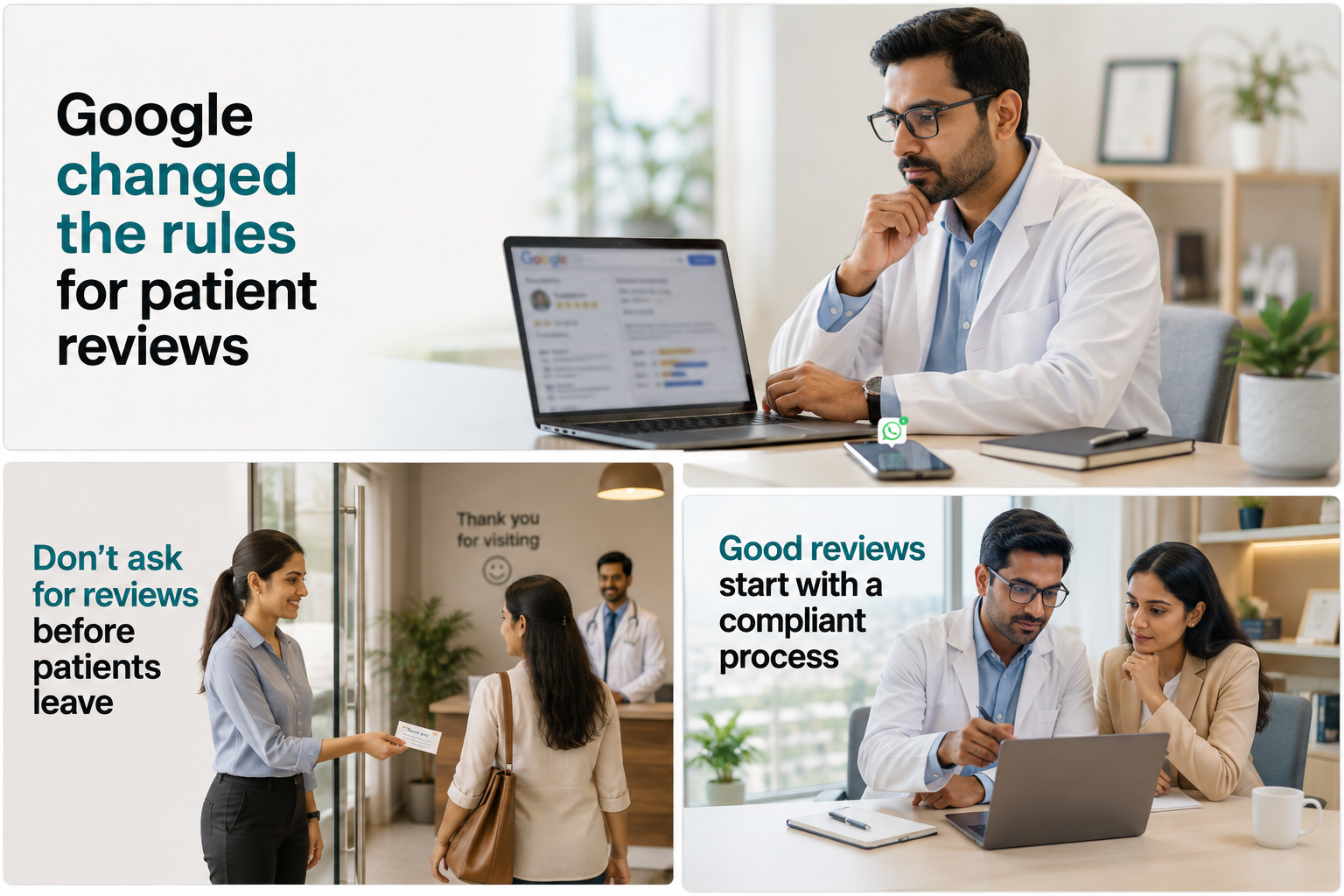
    Google’s own guidance explicitly permits displaying a review QR code in your store and on receipts; what it prohibits is requiring or pressuring a patient to review before they leave, gating by sentiment, or offering an incentive.

    Your front-desk team is managing check-ins, answering calls, processing payments, and handling a waiting room that never quite empties.

    Asking every departing patient to leave a review, without sounding pushy and without disrupting checkout, is not a realistic ask. Most clinics know they need more reviews. Very few have a system that collects them reliably, inside Google’s actual rules rather than a guess at them.

    Why Asking Patients Directly Isn’t a Reliable System

    Satisfied patients genuinely intend to leave a review after a good visit. The problem is that intention and action are separated by too many steps. By the time the patient has walked to the car, found their keys, and switched mental gears to the next item on their list, the moment has passed.

    There is no link saved anywhere, no prompt on their phone, and no reason to search out your Google listing voluntarily. The goodwill is real; the pathway to act on it usually isn’t there.

    Verbal requests also put the entire burden on the patient, at the exact moment they’re mentally checking out of the visit and moving on with their day. Passive collection systems exist to close that gap by giving the patient a direct, ready-made link at a moment they’re likely to actually use it.

    In the field, the pattern is consistent. A patient agrees a review would be no trouble, then spends the next while patting down a hospital bag for a phone buried under files and prescriptions, waiting for a signal to load, then either hunting for the camera app or searching for the clinic by name on Google themselves.

    Nobody wants to hold up the queue over it, so the polite way out is “I’ll do it once I’m home, pucca” — and that promise, made in good faith, quietly fades the moment they’re back in their own routine.

    There’s many a slip between the cup and the lip: a QR code asks a patient to get through four or five small steps in a row, under mild social pressure, with no guarantee the clinic’s network cooperates.

    A single NFC tap collapses nearly all of that into one motion — no camera, no search, no typing — whether the patient uses it right there at the counter or takes the card home for later.

    Google’s Current Review Rules — What Clinics Need to Know

    Google’s own Business Profile help pages and its Maps content policy draw a clear line, and it’s not the line the industry commentary around this topic usually assumes:

    • Making a review opportunity available is fine, including on the premises. Google’s own guidance for requesting reviews explicitly recommends printing and displaying a review QR code in your store, alongside adding it to receipts, thank-you emails, and WhatsApp messages.


    • Requiring or pressuring a patient to leave a review before they leave the premises is not. Google’s Maps content policy states this directly: merchants must not require or pressure users to leave ratings or write reviews while on the premises, and must not request that specific content be included (such as naming a staff member) or ask staff to hit a review quota.


    • Review gating has been prohibited for years. You cannot pre-screen patients by asking how their visit went and only sending happy ones to Google while routing unhappy ones elsewhere. Every patient gets the same link, regardless of how the visit went.


    • Incentivizing a review is prohibited outright — a discount, gift, or loyalty perk in exchange for a review risks the review itself and the wider profile.

    The practical takeaway: what matters is availability without pressure, not location or timing. A QR code on the counter, an NFC card at checkout, a take-home card, and a same-day WhatsApp message can all coexist — as long as nothing about any of them requires, pressures, gates by sentiment, or steers what the patient writes.

    Three Ways to Make Reviews Easy Without Pressuring Anyone

    QR Codes — On the Counter and On the Way Out

    A QR code can sit at the checkout counter, in the waiting room, or travel home with the patient on a receipt or appointment card — Google’s own guidance recommends displaying it in-store as well as adding it to takeaway materials.

    What makes it compliant isn’t where it’s placed; it’s that nobody is asked to complete it before they leave, and every patient sees the same code regardless of how their visit went.

    The code should link directly to your Google review page rather than sending the patient through a homepage or contact form.

    NFC Cards — A Single Tap, In-Clinic or Take-Home

    An NFC card is a small, programmable card holding a single stored link. When a phone taps it, the phone’s NFC reader picks up the signal and opens the linked page directly, no app and no typing required.

    It can sit at the checkout counter for a patient to tap on their way out if they’d like, or go home with them as a takeaway — either is fine, as long as it’s offered, not pushed, and nobody is held up over it.

    Technically, the card’s antenna draws a small amount of energy from the phone’s NFC field, wakes the chip, and sends the stored URL back in a single brief exchange. Because the card is passive, it needs no battery and no charging.

    Post-Visit SMS and WhatsApp Messages

    This is the cleanest channel from a compliance standpoint, since the patient reads and acts on it after they’ve already left the clinic. Send it the same day, while the visit is still fresh, with a short, neutral message and a direct link:

    “Hi [First Name], thanks for visiting [Clinic Name] today. If you have a minute, we’d really appreciate a quick Google review: [Review Link]. Thank you.”

    Nothing in the message should reference the patient’s condition, treatment, or any clinical detail — “thanks for visiting” is safer and more compliant than anything that presupposes a clinical relationship.

    What the Message Should Say (and What to Avoid)

    Keep review requests short, neutral, and fully open-ended. “Scan to share your experience” works because it doesn’t reference the patient’s condition and doesn’t steer what they write. Three rules keep this compliant on every front:

    • Under Clause 7.14 of the Code of Medical Ethics Regulations, 2002 — the doctor confidentiality provision currently in force, per NMC’s own 2023 notification reinstating the 2002 code — a registered medical practitioner may not disclose a patient’s secrets learned in the course of practice, with narrow exceptions (a court order, or a serious identified risk to a specific person). A review request that references the visit at all should stop at “thanks for visiting,” never the reason for it.


    • Under India’s Digital Personal Data Protection Act, 2023 (DPDPA), using a patient’s contact details for a review request needs to be covered by the clinic’s actual notice, consent, or other lawful basis for processing — the Act allows both consent-based and certain “legitimate use” grounds, not consent alone. Keeping the message free of clinical details reduces unnecessary disclosure, but it doesn’t by itself establish DPDPA compliance; that depends on the clinic’s actual notice and consent setup, which is a clinic-specific question rather than something a message template resolves on its own.


    • Under Google’s current review policy, don’t ask patients to mention a staff member by name or steer what the review should say. Keep the ask completely open-ended.

    Whether you use WhatsApp, SMS, or email, prepare pre-approved response templates for incoming reviews too — staff replying to a negative review without guidance can accidentally reveal sensitive patient details. Move detailed complaints offline and keep public replies generic and process-focused.

    Routing Reviews to the Right Profile in Multi-Provider Practices

    Google’s own Business Profile guidelines allow an individual practitioner — a doctor, dentist, or similar public-facing professional — to hold a dedicated profile separate from the practice’s location listing, provided they’re directly contactable at the verified location during stated hours; support staff don’t get their own profiles, and a single practitioner shouldn’t run multiple profiles to cover every specialization.

    For a multi-doctor or multi-location practice, that means routing matters as much as sending: if every automated message points to one generic link, reviews for a dermatology visit and a general practitioner visit land on the same profile, diluting visibility for both.

    Match the patient to the correct profile before the message goes out — getting this wrong at setup means months of reviews building the wrong listing.

    How Business Pilot Sets This Up for Your Clinic

    Business Pilot’s consultancy team configures the full system: QR assets formatted for both in-clinic display and print takeaways, NFC cards programmed to the correct Google Business Profile for use at the counter or as a takeaway, and automated SMS/WhatsApp sequences that follow up after the patient has left as a second, no-pressure layer.

    Profile routing is set up correctly from day one for multi-provider practices, and pre-approved response templates are provided for both positive and negative reviews. The clinic doesn’t need to buy software, manage a dashboard, or train staff on anything new.

    Entry is a one-time clinic verification fee that covers a full 30-day consultancy trial — no subscription, no auto-billing at the end of the trial, and no obligation to continue.

    The reason NFC sits at the centre of that setup rather than QR alone is the hospital-bag problem above — it’s the one point in the whole chain where a patient’s good intention most often quietly dies, and a single tap is the shortest possible distance between “yes, happily” and a review actually posted.

    The Reviews Aren’t Missing — the Path To Leave One Is

    Patients aren’t unwilling to leave reviews. They’re losing the path to do so somewhere between the consultation room and the car park, and the fix has to work within Google’s actual rules, not a guess at them. QR codes on the counter, NFC cards at checkout or in the patient’s hand to take home, and automated post-visit messages — offered, never required, and open to every patient alike — close that gap without asking anything of the doctor or the front desk.

    Frequently Asked Questions

    Is it against Google’s rules to collect reviews with a QR code or NFC card? 

    Not on its own, and not even if it’s on the counter — Google’s own guidance recommends displaying a review QR code in-store.

    What’s against the rules is requiring or pressuring a patient to complete it before they leave, gating by sentiment, or asking for specific content like a staff member’s name.

    What is review gating, and how do I avoid it?

    Review gating is asking patients how their visit went first, then only sending happy ones to Google while routing unhappy ones to a private form. Google has prohibited this for years.

    The fix is simple: every patient gets the same review link, regardless of how the visit went.

    Do I need to offer patients anything in exchange for a review?

    No, and you shouldn’t. Offering a discount, gift, or loyalty perk for a review is explicitly against Google’s policy and can put your whole profile at risk, not just the incentivized reviews.

    Does a patient need to install an app to use an NFC card?

    No. Modern smartphones read NFC tags natively. The patient taps the card with their phone, and the review page opens in the browser automatically.

    How do I keep review requests compliant with Indian patient-privacy rules?

    Keep the message about the visit experience, not the clinical encounter. Clause 7.14 of the currently operative Code of Medical Ethics Regulations, 2002 prohibits a registered medical practitioner from disclosing a patient’s secrets learned through practice.

    Separately, using a patient’s contact details for a review request needs to sit within the clinic’s actual notice and consent basis under the DPDPA 2023 — that’s a clinic-specific compliance question, not something resolved by wording alone.

    As a practical safeguard on top of both, Business Pilot recommends review requests never mention a diagnosis, treatment, or condition.

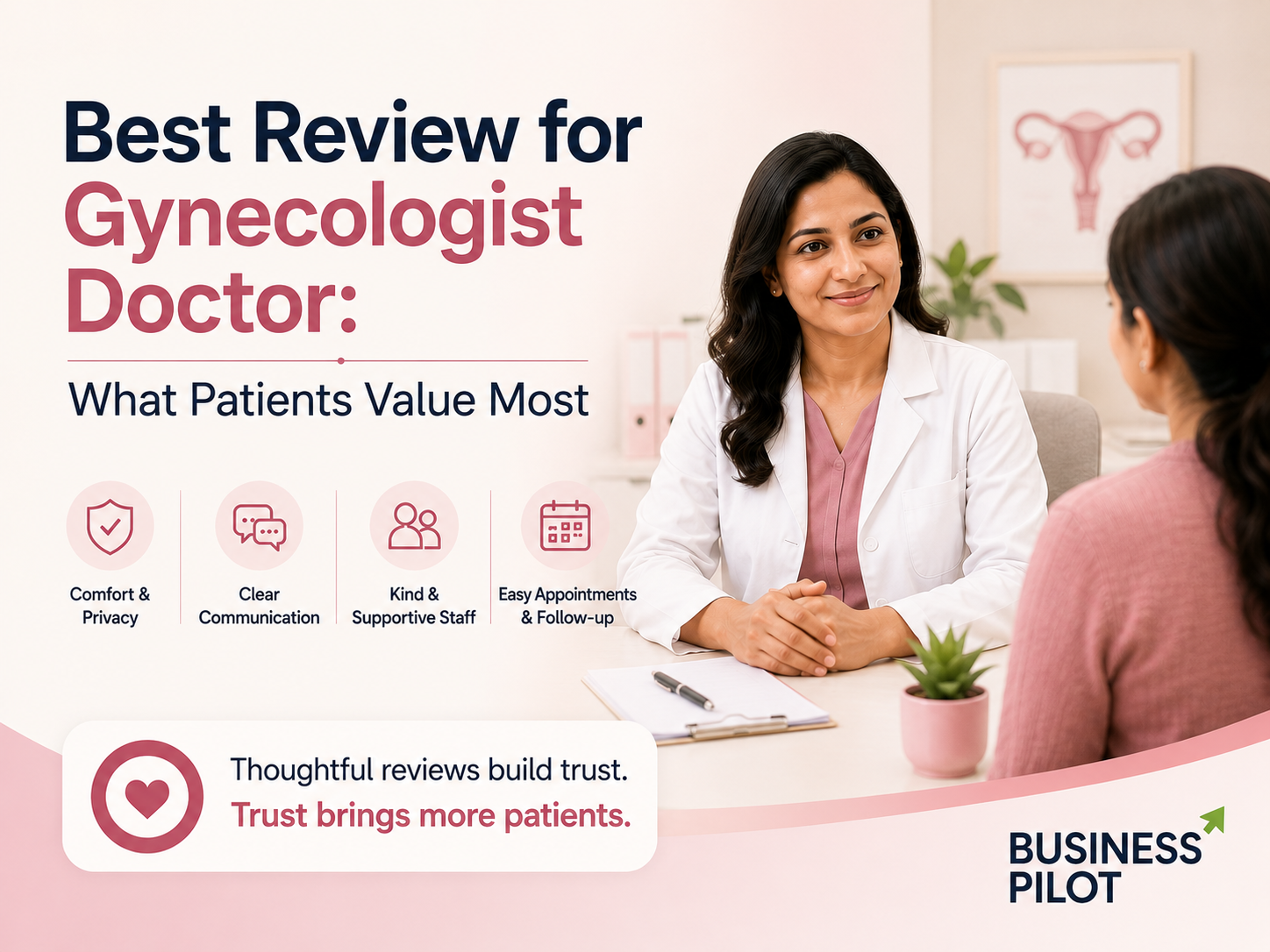
  • Best Review for Gynecologist Doctor: A Practical Guide

    Best Review for Gynecologist Doctor: A Practical Guide

    What Makes the Best Review for Gynecologist Doctor Searches Actually Return?

    Behind every “best review for gynecologist doctor” search is the same real question: what does a strong review actually say? Comfort, clear explanations, respected privacy, care without judgment — that’s what it describes, not just a star rating. That kind of specific detail helps a hesitant patient decide far more than a short five-star rating ever could.

    Gynecology is one of the most personal specialties a patient will ever visit. Reviews for gynecologists read differently from reviews for most other specialties, and copying a generic “leave us a review” approach often produces reviews that feel hollow rather than trustworthy.

    If you run a gynecology practice, you may have wondered why your reviews aren’t landing the way you’d expect. Or you may simply be unsure how to ask without making a patient uncomfortable. This guide walks through what genuinely works.

    A 2025 patient survey by healthcare reputation platform rater8 found 84% of patients check online reviews before choosing a new provider. Yet 57% rarely or never leave one for their own. (US survey data, cited as directional context; no India-specific figure was part of the supplied research — flagged as a gap, not assumed.) That gap is exactly why a respectful, well-timed ask matters.

    The Real Problem: Gynecology Reviews Are Harder to Ask For

    Most review-generation advice is written for specialties where the ask is easy — a dental cleaning, a physiotherapy session, a routine check-up. Gynecology carries a different weight, and it’s exactly why so many practices searching for the best review for gynecologist doctor strategies find generic advice doesn’t hold up. Patients may have discussed fertility struggles, pregnancy loss, contraception choices, or symptoms they’ve never told anyone else. Asking that same patient for a public review the way you’d ask after a haircut can feel tone-deaf, even with good intentions. Many practices under-ask here — not from lack of trying, but genuine uncertainty about how to do it respectfully.

    What “Best Review for Gynecologist Doctor” Actually Means

    A strong gynecologist review is not the longest one, or the one with the most superlatives. Patients researching a gynecologist online typically look for a small, consistent set of signals:

    • Comfort and privacy — did the practice make a sensitive visit feel safe and unhurried?
    • Clear explanation — did the doctor explain what was happening and why, in plain language?
    • Staff manner — front-desk and nursing staff often shape the review as much as the doctor does.
    • Practical logistics — appointment ease, wait times, follow-up availability.

    A review that speaks to even one of these specifically is more useful than a generic five-star rating. It helps a future patient deciding whether to book, and it helps search visibility too, since specific language reads as genuine rather than templated.

    This is the same principle covered in our companion article on what makes any doctor review genuinely useful. Gynecology simply narrows which details matter most.

    What Does a Good Gynecologist Review Actually Look Like?

    A good gynecologist review names something specific, rather than just awarding stars. How the doctor explained a condition, how staff handled a sensitive moment, how the visit felt overall — any of these makes a review useful. That specificity is what future patients respond to, and what search visibility rewards too.

    Consider two reviews for the same practice. The first reads: “Dr. Sharma is the best! Five stars!” The second reads: “I was nervous about my first visit, but the doctor explained everything clearly and never made me feel rushed. The front desk staff were kind when I called to reschedule.”

    Both are positive. Only the second one actually helps a hesitant patient decide to book — it answers the unspoken question every new gynecology patient has: will I be treated with care here? That’s the real standard worth aiming for. Not star count — specific, human detail.

    Reviews to avoid encouraging: anything disclosing a diagnosis, naming a procedure, or revealing details a patient might later regret making public. A vague “great experience!” isn’t useful either — it just doesn’t carry the privacy risk. The goal is specific and general: detail about the experience, not the medical particulars.

    How Should a Gynecology Practice Ask a Patient for a Review?

    Ask simply, at the right moment, without any exchange attached. Never for specific medical details, never right after a difficult visit, and never more than once with real pressure behind it. The mechanics below cover the how; the principle above is the whole of the “why.”

    1. Time the ask right. A follow-up visit, a normal check-up result, or a positive pregnancy milestone works far better than right after a difficult appointment. Reading the room matters more than a fixed rule.
    2. Keep it simple and non-specific. “Would you be willing to share your experience with our practice?” invites a genuine response without prompting her to disclose a diagnosis publicly.
    3. Make it effortless. A direct link — QR code, SMS, or WhatsApp — removes friction. Patients who intend to leave a review often forget if it takes more than a minute.
    4. Never request medical specifics. This is an ethical line, not a stylistic one. Encouraging a patient to name a diagnosis or procedure publicly creates a real privacy risk, and should never be part of staff training.
    5. Train staff once, consistently. The ask should feel like a natural, warm close to the visit — not a scripted line delivered the same way regardless of what that visit involved.
    6. Follow up once, gently. A single, low-pressure reminder a week or two later is reasonable if a patient doesn’t respond. Repeated requests start to feel like pressure.

    What Review Practices Should Gynecology Clinics Avoid?

    Avoid incentivised reviews, review gating, and writing or editing reviews on a patient’s behalf. All three violate Google’s review policies and put a listing’s entire review profile at risk, not just the one review in question.

    A handful of practices, trying to move faster, lean on shortcuts that create real risk:

    • Incentivised reviews — discounts, gifts, or free services for a review — violate Google’s Prohibited and Restricted Content policy and can get a listing’s reviews removed in bulk. That’s the same enforcement pattern covered in our article on the recent Google review policy update.
    • “Review gating” — asking only satisfied patients while quietly skipping dissatisfied ones — is against platform policy and, over time, produces a profile that reads as suspiciously uniform.
    • Writing or editing reviews on a patient’s behalf, even with good intentions, is a fabrication risk that damages trust the moment it’s noticed.

    The safest, most durable path is also the simplest: ask genuinely, ask consistently, and let the patient write her own words — even when that means a slower start.

    What Genuinely Useful Review Content Looks Like

    Practices sometimes ask what they should coach patients to write. The honest answer: nothing scripted. But it helps to know what tends to appear in reviews that actually influence a patient’s decision. It’s the kind of specific, unprompted detail that shows up when a patient genuinely felt cared for.

    • How a sensitive topic was raised or discussed (“didn’t rush me,” “explained my options without judgment”)
    • Specific mentions of staff behaviour, not just the doctor
    • References to follow-up (“called to check how I was doing”)
    • Practical detail a future patient would want (ease of booking, parking, how a change of plan was handled)

    None of this can be manufactured by asking for it directly — it shows up naturally when the visit was handled well and the ask afterward is simple and pressure-free.

    It’s rarely reluctance that keeps a good gynecologist review from happening. More often it’s uncertainty — the patient isn’t sure what’s appropriate to share publicly after a consultation that personal. A simple, general prompt removes that uncertainty without asking her to decide what’s “too much” to disclose.

    Frequently Asked Questions

    Can I ask a patient to mention her specific diagnosis or procedure in a review? No. Even with good intent, this creates a real privacy risk for that patient. Keep the ask general — “share your experience” — rather than specific to her condition or treatment.

    Is it ethical to request a Google review right after a sensitive consultation? It’s better avoided. Even a well-worded request can feel poorly timed immediately after a difficult or emotional visit. A routine follow-up or a positive-result visit is a more respectful moment to ask.

    Is it acceptable to offer a small discount in exchange for a review? No. Google’s Prohibited and Restricted Content policy treats incentivised reviews as a violation — anything exchanged for a review, positive or otherwise. It can result in reviews being removed at scale. Ask without any exchange attached.

    What if a review mentions a long wait time or a scheduling issue? That’s genuine, useful feedback. Responding calmly and professionally, without defensiveness, does more for trust than trying to prevent any negative review from appearing at all.

    Should front-desk staff be the ones asking for reviews? Often, yes. A warm, natural ask at checkout from staff who were part of the visit tends to land better than an automated message sent hours later with no context.

    Key Takeaways

    • – The best review for gynecologist doctor searches keep surfacing the same pattern: specific detail — comfort, clarity, and staff manner beats star count every time.
    • Never ask a patient to name a diagnosis or procedure in a public review; keep the ask general.
    • Never offer an incentive for a review, and never selectively ask only satisfied patients.
    • Time the ask for a routine or positive visit, not immediately after a difficult one.
    • Patient privacy expectations vary by individual — what one patient is comfortable sharing publicly, another isn’t. The ask should never assume otherwise, and practices should apply their own judgement alongside applicable privacy regulations when deciding how review requests are handled.

    For Gynecology Practices Across India

    This approach applies whether a practice is in a metro hospital, an independent clinic, or a women’s health centre. The best review for gynecologist doctor strategy doesn’t change with city or practice size — the emphasis on privacy, comfort, and genuine timing holds regardless.

    If your practice is weighing how to build a stronger, policy-safe review presence, we’re happy to walk through what that could look like — a strategy built specifically for gynecology. No pressure on patients, none on staff.

     — reach out and we’ll talk through it.

    Why Practices Work With Business Pilot

    Reputation management done well isn’t about maximising review volume — it’s about building a review profile a patient can actually trust, one that stays compliant as platform policies evolve. Our approach for gynecology and other sensitive specialties is built around ethical, privacy-first review generation: no incentives, no gating, no scripted asks that ignore what a specific visit involved. That’s a deliberate trade-off — slower growth in exchange for a profile that holds up under scrutiny, from patients and from Google alike.


    Educational content for medical practices; not a substitute for practice-specific legal or compliance advice regarding patient privacy or platform policy.

  • Google Review Policy Update 2026: Critical Changes Explained

    Google Review Policy Update 2026: Critical Changes Explained

    Search intent this article answers

    If a review has disappeared from your Google Business Profile recently, or a patient has told you their review “didn’t go through,” you’re not imagining it and you’re not alone. A genuine Google review policy update rolled out in 2026, changing real, substantial parts of how it evaluates reviews. Several long-standing clinic habits — ones many practices have used for years without issue — now fall on the wrong side of the rules. This article explains exactly what changed, why it’s affecting clinics specifically, and what a compliant process looks like going forward.

    The problem: a review process that worked last year may not work now

    For years, the standard advice for getting more Google reviews was simple. Ask patients before they leave, make it easy with a tablet or QR code at reception, and encourage them to mention the doctor by name. It felt like harmless extra local-SEO value. That advice is now the exact thing getting reviews rejected.

    Google made two separate changes to its Business Profile review policy within 48 hours of each other in April 2026, and neither was a minor tweak. On April 16, Google published its 2025 Trust and Safety Report and confirmed that Gemini-powered moderation was now live. Review edits and new submissions are now screened by AI before they publish, not just after a complaint.

    On April 17, Google quietly rewrote the text of its Rating Manipulation policy, adding two explicit new prohibitions. Reviews that would have quietly stayed up a year ago are now being caught, flagged, and removed before they ever go public. In some cases, the practice’s whole profile gets flagged for closer scrutiny, which can affect reviews that had nothing to do with the original issue.

    What actually changed

    This Google review policy update breaks down into two parts: genuinely new rules, and older rules that are now actively enforced.

    Two genuinely new rules:

    1. No review quotas for staff. Setting a target — “get 10 five-star reviews this month” — or tying any bonus or incentive to staff hitting a review number is now explicitly against policy.
    2. No directing patients to include specific content. Asking a patient to mention a doctor or staff member by name in their review is now a violation, even when the intention was simply to help local SEO. A patient who mentions a doctor’s name entirely on their own is still completely fine. The rule is about the clinic directing what goes into the review, not the mention itself.

    Older rules, now actively enforced under this Google review policy update:

    • No requesting a review while the patient is still on the premises. A verbal ask at the reception desk, before the patient has left, is a violation.
    • No shared devices for collecting reviews. A tablet at the front desk, or an in-clinic review kiosk, is explicitly prohibited. This isn’t about where it physically sits — it’s because it creates a detectable pattern (more on this below).
    • No “review gating.” Screening patients by how satisfied they seemed before deciding whether to send them the review link is banned. Every patient gets the same, neutral request.
    • No incentives. Discounts, gift vouchers, or loyalty perks in exchange for a review were always against policy, and remain so — including offering an incentive to edit or remove a negative review.

    How Google actually detects this (and why it isn’t a location check)

    Google is not checking a patient’s live GPS location the moment they submit a single review and deciding, in real time, whether to accept it. What its systems actually look for is a pattern across multiple reviews. That means the same device, IP address, or clinic Wi-Fi network being used repeatedly. This especially applies when reviews from that source arrive in an unnatural burst or use noticeably similar phrasing. A shared front-desk tablet creates exactly that pattern: dozens of reviews from one device, on one network, often within the same short window. That’s what gets flagged, not simply where the reviewer happened to be standing.

    This distinction matters in practice for one increasingly common tool: NFC “tap to review” cards. The card itself isn’t the issue — it’s just a faster way to open a review link than typing a business name into search. What matters is what happens next.

    A card mounted on a stand at reception risks recreating the same shared-location, same-network pattern as a kiosk. This applies whenever a patient taps it and is expected to complete the review immediately, before checking out. A card handed to the patient to take home is different. Tapped once as a convenience and completed later on their own connection, it functions the same as a text or email link, and carries the same low risk.

    Why Google is rejecting doctor reviews from clinics specifically

    Clinics are affected because several long-standing review-collection habits — a front-desk tablet, a name-mention request, asking before a patient leaves — now trigger Google’s stricter, AI-assisted enforcement. None of these habits are new; what changed is that Google’s systems now catch them at scale. A front-desk tablet fits naturally into a patient’s checkout flow, and encouraging a name mention felt like harmless, common-sense local SEO. Neither was ever fully compliant — they were simply common enough, and lightly enforced enough, that most practices never had a problem. That’s the part that changed. The underlying policy is mostly the same; the enforcement behind it is not.

    What’s actually at risk (not just the individual review)

    This is where the Google review policy update has the most teeth. A violation costs more than a single missing review:

    • Review removal. The specific reviews tied to a non-compliant collection method are the first thing removed.
    • Profile-wide scrutiny. A detected pattern can prompt Google to review the whole profile’s history, which can affect reviews that had nothing to do with the original issue.
    • Temporary restrictions. Repeated violations can lead to a profile being blocked from receiving new reviews for a period, or having existing reviews unpublished. Google doesn’t publish a fixed duration for these restrictions — it varies by case.
    • Lost momentum, not just lost reviews. A profile that’s been collecting steadily for a year loses more than the flagged reviews — it loses the recency and volume pattern that took months to build.

    None of this is designed to alarm. It’s simply what Google’s own enforcement guidance documents, and it’s why addressing the collection method matters more than waiting out a single rejected review.

    What a compliant review process looks like now

    Here’s what a review-collection process that respects the Google review policy update actually looks like, step by step:

    1. Send the request after the patient has left, via SMS, WhatsApp, or email — never verbally at the counter, and never on a shared device.
    2. Ask every patient the same way, regardless of how the visit seemed to go. No pre-screening, no routing unhappy patients elsewhere first.
    3. Never direct what goes into the review. No scripts, no “please mention Dr. [Name],” no suggested phrases.
    4. Space requests out. A burst of reviews landing in a short window looks like manipulation to Google’s systems, even if every review is genuine. Send requests on a steady drip, not in batches.
    5. Respond to every review, positive and negative, calmly and without disputing details publicly. This part of the process is unaffected by the update and remains the single best trust signal available.
    6. If using an NFC or QR card, hand it to the patient rather than mounting it at a checkout station, and don’t prompt immediate on-the-spot completion.

    ✓ Compliant

    • SMS sent after the appointment
    • Email sent later that day
    • WhatsApp follow-up
    • Neutral wording, no scripted phrases
    • Patient completes it on their own device, in their own time

    ✗ Non-compliant

    • Reception tablet or kiosk
    • Asking before the patient leaves
    • “Please mention Dr. [Name]”
    • Review quotas for staff
    • Incentives (discounts, gifts, loyalty points)
    • Screening out unhappy patients before sending the link

    What to do if reviews have already disappeared

    If reviews have vanished or a patient reports theirs “didn’t go through,” the fix isn’t to keep resubmitting the same request. This Google review policy update means the fix has to happen at the process level, not the individual review. Review the collection process itself first: was a shared device involved, was the request made verbally at the counter, or did requests recently arrive in a noticeable burst? Removing the underlying practice — not just waiting it out — is what stops further removals. Google does provide an appeal path through Business Profile Help for profiles that believe a restriction was applied incorrectly. The more durable fix, though, is addressing the collection method itself.

    Frequently asked questions

    Why did my Google review disappear?
    Most disappearances trace back to a detectable pattern created by this Google review policy update’s stricter enforcement. Reviews collected on a shared device, requested verbally on the premises, or arriving in an unusual burst are the common cause — not a problem with any single review’s content.

    Is a reception tablet or kiosk still allowed?
    No. Shared devices used to collect reviews on-site are explicitly against the current Google review policy update, regardless of how long the practice has used one without issue before.

    Can a patient still mention my name in their review?
    Yes, if they do it entirely on their own. What’s no longer allowed is the clinic asking or coaching a patient to include a specific name or phrase.

    Are NFC tap-to-review cards banned?
    No, the card itself isn’t restricted. What matters is whether the patient completes the review immediately on the premises (risky) or takes the card and completes it later, off-site (low risk).

    Will this affect reviews we already have?
    Existing reviews aren’t automatically removed by the policy update itself. But a pattern detected in past collection methods can prompt Google to review a profile’s history, which is why auditing past practices matters, not just future ones.

    Can doctors ask patients for reviews at all?
    Yes. Asking is completely fine — what changed is how and when. A neutral request sent after the patient leaves, through their own device, is compliant. The same request made verbally at the counter, or through a shared device, isn’t.

    How long do review restrictions typically last?
    Google doesn’t publish a fixed duration — restrictions are applied case by case and can range from a temporary pause on new reviews to a longer profile-wide review. Addressing the underlying collection method is what ends the restriction, not simply waiting.

    Where this fits into your wider reputation strategy

    This update doesn’t change why reviews matter. They remain one of the strongest signals patients use to choose a doctor. They’re also one of the clearest ways your practice shows up when patients ask AI tools like ChatGPT or Gemini for a recommendation. Adapting to this Google review policy update is really just about the mechanics of collecting reviews safely, not a change to the strategy itself. A practice that adjusts its process now avoids losing months of accumulated reviews to an enforcement action later.

    Get your review process audited — a short review of your current collection method against the 2026 rules, before a rejected review becomes a bigger problem.

    Why we track this

    Google didn’t send an email or banner announcing the April 2026 changes — most practices only find out after a review has already been rejected. Part of managing a clinic’s digital presence is watching for changes like this one before they turn into a lost review. Adjusting the collection process early avoids a bigger problem than a single rejected review.

    References

    The following official Google sources back the claims made throughout this Google review policy update breakdown:


    This article is educational content about platform-compliance practices and does not constitute legal advice. Google’s Business Profile policies and enforcement practices continue to evolve — verify current terms directly on Google Business Profile Help before making process changes.